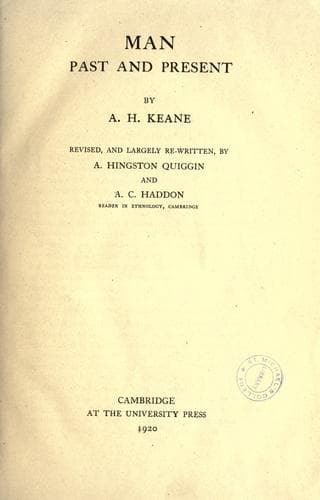
Man, Past and PresentKeane, A. H. (Augustus Henry)
History
Man, Past and Present
Keane, A. H. (Augustus Henry)
Anthropology; Ethnology
[655] I have not thought it desirable to touch on the interminable
controversy respecting the ethnical relations of the Hiung-nu, regarding
them, not as a distinct ethnical group, but like the Huns, their later
western representatives, as a heterogeneous collection of Mongol,
Tungus, Turki, and perhaps even Finnish hordes under a Mongol military
caste. At the same time I have little doubt that Mongolo-Tungus elements
greatly predominated in the eastern regions (Mongolia proper, Manchuria)
both amongst the Hiung-nu and their Yuan-yuan (Sien-pi) successors, and
that all the founders of the first great empires prior to that of the
Turki Assena in the Altai region (sixth century A.D.) were full-blood
Mongols, as indeed recognised by Jenghiz-Khan himself. For the
migrations of these and neighbouring peoples, consult A. C. Haddon, _The
Wanderings of Peoples_, 1911, pp. 16 and 28.
[656] On the authority of the Wei-Shu documents contained in the
Wei-Ch[=i], E. H. Parker gives (in the _China Review_ and _A Thousand
Years of the Tartars_, Shanghai, 1895) the dates 386-556 A.D. as the
period covered by the "Sien-pi Tartar dynasty of Wei." This is not to be
confused with the Chinese dynasty of Wei (224-264, or according to Kwong
Ki-Chiu 234-274 A.D.). The term "Tartar" (Ta-Ta), it may be explained,
is used by Parker, as well as by the Chinese historians generally, in a
somewhat wide sense, so as to include all the nomad populations north of
the Great Wall, whether of Tungus (Manchu), Mongol, or even Turki stock.
The original tribes bearing the name were Mongols, and Jenghiz-Khan
himself was a Tata on his mother's side.
[657] Mrs Bishop, _Korea and Her Neighbours_, 1898.
[658] T. de Lacouperie says on "a Tibeto-Indian base" (_Beginnings of
Writing in Central and Eastern Asia_, 1894, p. 148); and E. H. Parker:
"It is demonstrable that the Korean letters are an adaptation from the
Sanskrit," _i.e._ the Devanagari (_Academy_, Dec. 21, 1895, p. 550).
[659] See p. 261. Also Koganei, "Ueber die Urbewohner von Japan," _Mitt.
d. Deutsch. Gesell. f. Natur- u. Voelkerkunde Ostasiens_, IX. 3, 1903,
containing an exhaustive review of recent literature, and N. G. Munro,
_Prehistoric Japan_, 1912.
[660] J. Deniker, _Races of Man_, 1900, pp. 371-2. See also J.
Batchelor, _The Ainu of Japan_, 1892, and the article "Ainus" in _Ency.
of Religion and Ethics_, 1908.
[661] G. Baudens, _Bul. Soc. Geogr._ X. p. 419.
[662] See especially E. Baelz, "Die koerperlichen Eigenschaften der
Japaner," in _Mitt. der Deutsch. Gesell. f. Natur- u. Voelkerkunde
Ostasiens_, 28 and 32.
[663] _Cruise of the Marchesa_, 1886, I. p. 36.
[664] _Geogr. Journ._ 1895, II. p. 318.
[665] _Geogr. Journ._ 1895, II. p. 460.
[666] _Journ. Anthrop. Soc._ 1897, p. 47 sq.
[667] _Ibid._ p. 58.
[668] Ripley and Dana, _Amer. Cyc._ IX. 538.
Public-domain text, read in full here on John Shaqi.
Reviews
Reviews
No reviews yet
Be the first to share your thoughts on this work.
Elsewhere in the archive
Join the Discussion
Join the discussion
Sign in to leave a comment or review.
Sign InorCreate an account