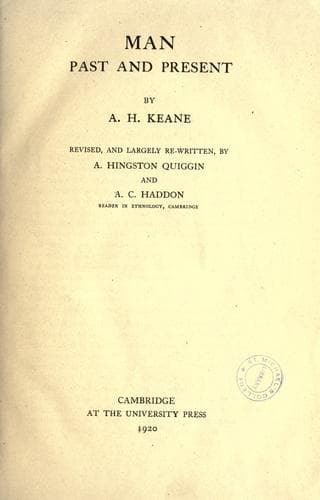
Man, Past and PresentKeane, A. H. (Augustus Henry)
History
Man, Past and Present
Keane, A. H. (Augustus Henry)
Anthropology; Ethnology
E. H. Parker unfortunately lent the weight of his authority to the
statement that the word "Tuerkoe" [Turki] "goes no farther back than the
fifth century of our era," and that "so far as recorded history is
concerned the name of Turk dates from this time[679]." But Turki tribes
bearing this national name had penetrated into East Europe hundreds of
years before that time, and were already seated on the Tanais (Don)
about the new era. They are mentioned by name both by Pomponius
Mela[680] and by Pliny[681], and to the same connection belonged, beyond
all doubt, the warlike _Parthians_, who 300 years earlier were already
seated on the confines of Iran and Turan, routed the legions of Crassus
and Antony, and for five centuries (250 B.C.-229 A.D.) usurped the
throne of the "King of Kings," holding sway from the Euphrates to the
Ganges, and from the Caspian to the Indian Ocean. Direct descendants of
the Parthians are the fierce Turkoman nomads, who for ages terrorised
over all the settled populations encircling the Aralo-Caspian
depression. Their power has at last been broken by the Russians, but
they are still politically dominant in Persia[682]. They have thus been
for many ages in the closest contact with Caucasic Iranians, with the
result that the present Turkoman type is shown by J. L. Yavorsky's
observations to be extremely variable[683].
Both the Parthians and the _Massagetae_ have been identified with the
_Yue-chi_, who figured so largely in the annals of the Han dynasties,
and are above mentioned as having been driven west to Sungaria by the
Hiung-nu after the erection of the Great Wall. It has been said that,
could we follow the peregrinations of the Yue-chi bands from their early
seats at the foot of the Kinghan mountains to their disappearance amid
the snows of the Western Himalayas, we should hold the key to the
solution of the obscure problems associated with the migrations of the
Mongolo-Turki hordes since the torrent of invasion was diverted
westwards by Shih Hwang Ti's mighty barrier. One point, however, seems
clear enough, that the Yue-chi were a different people both from the
Parthians who had already occupied Hyrcania (Khorasan) at least in the
third century B.C., if not earlier, and from the Massagetae. For the
latter were seated on the Yaxartes (Sir-darya) in the time of Cyrus
(sixth century B.C.), whereas the Yue-chi still dwelt east of Lake Lob
(Tarim basin) in the third century. After their defeat by the Hiung-nu
and the Usuns (201 and 165 B.C.), they withdrew to Sogdiana
(Transoxiana), reduced the _Ta-Hia_ of Baktria, and in 126 B.C.
overthrew the Graeco-Baktrian kingdom, which had been founded after the
death of Alexander towards the close of the fourth century. But in the
Kabul valley, south of the Hindu-Kush, the Greeks still held their
ground for over 100 years, until Kadphises I., king of the Kushans--a
branch of the Yue-chi--after uniting the whole nation in a single
Public-domain text, read in full here on John Shaqi.
Reviews
Reviews
No reviews yet
Be the first to share your thoughts on this work.
Elsewhere in the archive
Join the Discussion
Join the discussion
Sign in to leave a comment or review.
Sign InorCreate an account