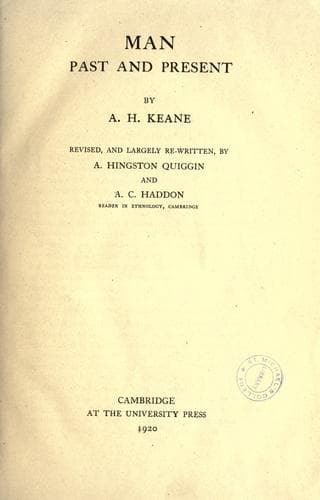
Man, Past and PresentKeane, A. H. (Augustus Henry)
History
Man, Past and Present
Keane, A. H. (Augustus Henry)
Anthropology; Ethnology
In Russia, Rumania (Dacia), and most of the Balkan Peninsula these
Mongolo-Turki blends have been again submerged by the dominant Slav and
Rumanian peoples (Great and Little Russians, Servo-Croatians,
Montenegrini, Moldavians, and Walachians). But in south-western Asia
they still constitute perhaps the majority of the population between the
Indus and Constantinople, in many places forming numerous compact
communities, in which the Mongolo-Turki physical and mental characters
are conspicuous. Such, besides the already mentioned Turkomans of
Parthian lineage, are all the nomad and many of the settled inhabitants
of Khiva, Ferghana, Karategin, Bokhara, generally comprised under the
name of Uzbegs and "Sartes." Such also are the Turki peoples of Afghan
Turkestan, and of the neighbouring uplands (Hazaras and Aimaks who claim
Mongol descent, though now of Persian speech); the Aderbaijani and many
other more scattered groups in Persia; the Nogai and Kumuk tribes of
Caucasia, and especially most of the nomad and settled agricultural
populations of Asia Minor. The Anatolian peasantry form, in fact, the
most numerous and compact division of the Turki family still surviving
in any part of their vast domain between the Bosporus and the Lena.
Out of this prolific Oghuz stock arose many renowned chiefs, founders of
vast but somewhat unstable empires, such as those of the Gasnevides, who
ruled from Persia to the Indus; the Seljuks, who first wrested the
Asiatic provinces from Byzantium; the Osmanli, so named from Othman, the
Arabised form of Athman, who prepared the way for Orkhan (1326-60), true
builder of the Ottoman power, which has alone survived the shipwreck of
all the historical Turki states. The vicissitudes of these monarchies,
looked on perhaps with too kindly an eye by Gibbon, belong to the domain
of history, and it will suffice here to state that from the ethnical
standpoint the chief interest centres in that of the Seljukides,
covering the period from about the middle of the eleventh to the middle
of the thirteenth century. It was under Togrul-beg of this dynasty
(1038-63) that "the whole body of the Turkish nation embraced with
fervour and sincerity the religion of Mahomet[702]." A little later
began the permanent Turki occupation of Asia Minor, where, after the
conquest of Armenia (1065-68) and the overthrow of the Byzantine emperor
Romanus Diogenes (1071), numerous military settlements, followed by
nomad Turkoman encampments, were established by the great Seljuk rulers,
Alp Arslan and Malek Shah (1063-92), at all the strategical points.
These first arrivals were joined later by others fleeing before the
Mongol hosts led by Jenghiz-Khan's successors down to the time of
Timur-beg. But the Christians (Greeks and earlier aborigines) were not
exterminated, and we read that, while great numbers apostatised, "many
thousand children were marked by the knife of circumcision; and many
Public-domain text, read in full here on John Shaqi.
Reviews
Reviews
No reviews yet
Be the first to share your thoughts on this work.
Elsewhere in the archive
Join the Discussion
Join the discussion
Sign in to leave a comment or review.
Sign InorCreate an account