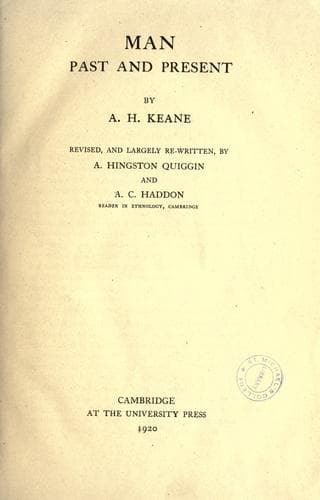
Man, Past and PresentKeane, A. H. (Augustus Henry)
History
Man, Past and Present
Keane, A. H. (Augustus Henry)
Anthropology; Ethnology
After reducing the whole of Pannonia and ravaging Carinthia and Friuli,
the Hunagars raided Bavaria and Italy (899-900), imposed a tribute on
the feeble successor of Arnulf (910), and pushed their plundering
expeditions as far west as Alsace, Lorraine, and Burgundy, everywhere
committing atrocities that recalled the memory of Attila's savage
hordes. Trained riders, archers and javelin-throwers from infancy, they
advanced to the attack in numerous companies following hard upon each
other, avoiding close quarters, but wearing out their antagonists by the
persistence of their onslaughts. They were the scourge and terror of
Europe, and were publicly proclaimed by the Emperor Otto I. (955) the
enemies of God and humanity.
This period of lawlessness and savagery was closed by the conversion of
Saint Stephen I. (997-1038), after which the Magyars became gradually
assimilated in type and general culture, but not in speech, to the
western nations[733]. Their harmonious and highly cultivated language
still remains a typical member of the Ural-Altaic family, reflecting in
its somewhat composite vocabulary the various Finno-Ugric and Turki
elements (Ugrians and Permians from the Urals, Volga Finns, Turki Avars
and Khazars), of which the substratum of the Magyar nation is
constituted[734].
"The modern Magyars," says Peisker, "are one of the most varied
race-mixtures on the face of the earth, and one of the two chief Magyar
types of today--traced to the Arpad era [end of ninth century] by
tomb-findings--is dolichocephalic with a narrow visage. There we have
before us Altaian origin, Ugrian speech and Indo-European type
combined[735]."
Public-domain text, read in full here on John Shaqi.
Reviews
Reviews
No reviews yet
Be the first to share your thoughts on this work.
Elsewhere in the archive
Join the Discussion
Join the discussion
Sign in to leave a comment or review.
Sign InorCreate an account