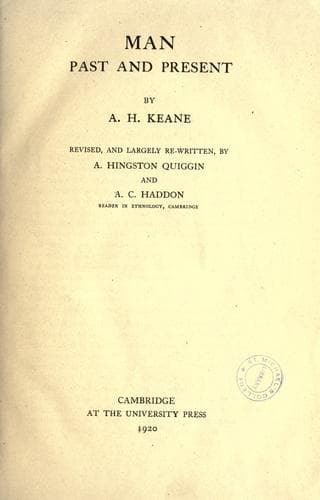
Man, Past and PresentKeane, A. H. (Augustus Henry)
History
Man, Past and Present
Keane, A. H. (Augustus Henry)
Anthropology; Ethnology
persistent, and that a language which is dependent for its existence
upon oral tradition is not easily modified[775]." A test case is the
Delaware (Leni Lenape), an Algonquian tongue which, judging from the
specimens collected by Th. Campanius about 1645, has undergone but
slight modification during the last 250 years.
In this connection the important point to be noticed is the fact that
some of the stock languages have an immense range, while others are
crowded together in indescribable confusion in rugged upland valleys, or
about river estuaries, or in the recesses of trackless woodlands, and
this strangely irregular distribution prevails in all the main divisions
of the continent. Thus of Powell's 58 linguistic families in North
America as many as 40 are restricted to the relatively narrow strip of
coastland between the Rocky Mountains and the Pacific, ten are dotted
round the Gulf of Mexico from Florida to the Rio Grande, and two
disposed round the Gulf of California, while nearly all the rest of the
land--some six million square miles--is occupied by the six widely
diffused Eskimauan, Athapascan, Algonquian, Iroquoian, Siouan, and
Shoshonian families. The same phenomenon is presented by Central and
South America, where less than a dozen stock languages--Opatan,
Nahuatlan, Huastecan, Chorotegan, Quichuan, Arawakan, Gesan (Tapuyan),
Tupi-Guaranian, Cariban--are spread over millions of square miles, while
many scores of others are restricted to extremely narrow areas. Here the
crowding is largely determined, as in Caucasia, by the altitude (Andes
in Colombia, Ecuador, Peru, and Bolivia; Sierras in Mexico).
It is strongly held by many American ethnologists that the various
cultures of America are autochthonous, nothing being borrowed from the
Old World. J. W. Powell[776], who rendered such inestimable services to
American anthropology, affirmed that "the aboriginal peoples of America
cannot be allied preferentially to any one branch of the human race in
the Old World"; that "there is no evidence that any of the arts of the
American Indians were borrowed from the Orient"; that "the industrial
arts of America were born in America, America was inhabited by tribes
at the time of the beginning of industrial arts. They left the Old World
before they had learned to make knives, spear and arrowheads, or at
least when they knew the art only in its crudest state. Thus primitive
man has been here ever since the invention of the stone knife and the
stone hammer." He further contended that "the American Indian did not
derive his forms of government, his industrial or decorative arts, his
languages, or his mythological opinions from the Old World, but
developed them in the New"; and that "in the demotic characteristics of
the American Indians, all that is common to tribes of the Orient is
universal, all that distinguishes one group of tribes from another in
America distinguishes them from all other tribes of the world."
Public-domain text, read in full here on John Shaqi.
Reviews
Reviews
No reviews yet
Be the first to share your thoughts on this work.
Elsewhere in the archive
Join the Discussion
Join the discussion
Sign in to leave a comment or review.
Sign InorCreate an account