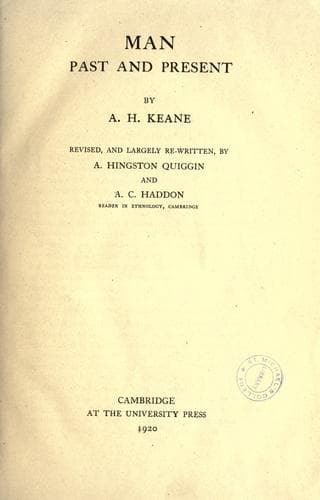
Man, Past and PresentKeane, A. H. (Augustus Henry)
History
Man, Past and Present
Keane, A. H. (Augustus Henry)
Anthropology; Ethnology
Walter Hough[783] gives various cultural parallels between America and
the other side of the Pacific but does not commit himself. S. Hagar[784]
brings forward some interesting correspondences between the astronomy of
the New and of the Old Worlds, but adopts a cautious attitude.
More recently the problem has been attacked with great energy by G.
Elliot Smith[785]. His investigations into the processes of
mummification and the tombs of ancient Egypt led him to comparative
studies, and he notes that certain customs seem to be found in
association, forming what is known as a culture-complex. For example,
"in most regions the people who introduced the habit of megalithic
building and sun worship also brought with them the practice of
mummification." Also associated with these are:--stories of dwarfs and
giants, belief in the indwelling of gods and great men in megalithic
monuments, the use of these structures in a particular manner for
special council, the practice of hanging rags on trees in association
with such monuments, serpent worship, tattooing, distension of the lobe
of the ear, the use of pearls, the conch-shell trumpet, etc. In a map
showing the distribution of this "heliolithic" culture-complex he
indicates the main lines of migration to America, one across the
Aleutian chain and down the west coast to California, the other and more
important one, across the Pacific to Peru, and thence to various parts
of South America, through Central America to the southern half of the
United States. Contrary to Schmidt, Elliot Smith postulates contact of
cultures rather than actual migrations of people; he considers it
possible that a small number of aliens arriving by sea in Peru, for
example, might introduce customs of a highly novel and subversive
character which would take root and spread far and wide. The Peruvian
custom of embalming the dead certainly presents analogies to that of
ancient Egypt, and Elliot Smith is convinced that "the rude megalithic
architecture of America bears obvious evidence of the same inspiration
which prompted that of the Old World." In a later paper Elliot
Smith[786] adduces further evidence in support of his thesis "that the
essential elements of the ancient civilization of India, Further Asia,
the Malay Archipelago, Oceania, and America were brought in succession
to each of these places by mariners, whose oriental migrations (on an
extensive scale) began as trading intercourse between the Eastern
Mediterranean and India some time after 800 B.C. and continued for many
centuries." This dissemination was in the first instance due to the
Phoenicians and there are "unmistakable tokens that the same Phoenician
methods which led to the diffusion of this culture-complex in the Old
World also were responsible for planting it in the New[787] some
centuries after the Phoenicians themselves had ceased to be" (_l.c._ p.
27). Further evidence along the same lines is offered by W. J.
Public-domain text, read in full here on John Shaqi.
Reviews
Reviews
No reviews yet
Be the first to share your thoughts on this work.
Elsewhere in the archive
Join the Discussion
Join the discussion
Sign in to leave a comment or review.
Sign InorCreate an account