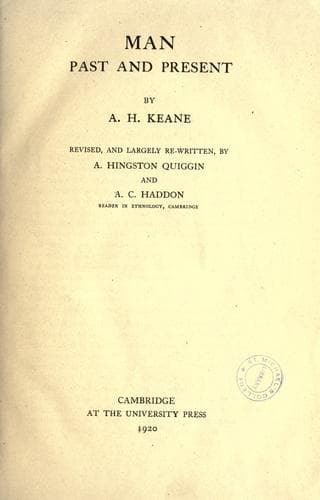
Man, Past and PresentKeane, A. H. (Augustus Henry)
History
Man, Past and Present
Keane, A. H. (Augustus Henry)
Anthropology; Ethnology
plateau tribes are the Ute, Shoshoni, Mono and Luiseno. _Yuman_, from
Arizona to Lower California.
From the data available J. R. Swanton and R. B. Dixon draw the following
conclusions[802]. "It appears that the origin of the tribes of several
of our stocks may be referred back to a swarming ground, usually of
rather indefinite size but none the less roughly indicated. That for the
Muskhogeans, including probably some of the smaller southern stocks,
must be placed in Louisiana, Arkansas and perhaps the western parts of
Mississippi and Tennessee, although a few tribes seem to have come from
the region of the Ohio. That for the Iroquoians would be along the Ohio
and perhaps farther west, and that of the Siouans on the lower Ohio and
the country to the north including part at least of Wisconsin. The
dispersion area for the Algonquians was farther north about the Great
Lakes and perhaps also the St Lawrence, and that for the Eskimo about
Hudson Bay or between it and the Mackenzie river. The Caddoan peoples
seem to have been on the southern plains from earliest times. On the
north Pacific coast we have indications that the flow of population has
been from the interior to the coast. This seems certain in the case of
the Indians of the Chimmesayan stock and some Tlinglit subdivisions.
Some Tlinglit clans, however, have moved from the neighbourhood of the
Nass northward. Looking farther south we find evidence that the coast
Salish have moved from the inner side of the coast ranges, while a small
branch has subsequently passed northward to the west of it. The
Athapascan stock in all probability has moved southward, sending one arm
down the Pacific coast, and a larger body presumably through the Plains
which reached as far as northern Mexico. Most of the stocks of the Great
Plateau and of Oregon and California show little evidence of movement,
such indications as are present, however, pointing toward the south as a
rule. The Pueblo Indians appear to have had a mixed origin, part of them
coming from the north, part from the south. In general there is to be
noted a striking contrast between the comparatively settled condition of
those tribes west of the Rocky mountains and the numerous movements,
particularly in later times, of those to the east."
With regard to the Pacific coast Dixon[803] notes that it "has
apparently been occupied from the earliest times by peoples differing
but little in their culture from the tribes found in occupancy in the
sixteenth century. Cut off from the rest of the country by the great
chain of the Cordilleras and the inhospitable and arid interior
plateaus, the tribes of this narrow coastal strip developed in
comparative seclusion their various cultures, each adopted to the
environment in which it was found....
Public-domain text, read in full here on John Shaqi.
Reviews
Reviews
No reviews yet
Be the first to share your thoughts on this work.
Elsewhere in the archive
Join the Discussion
Join the discussion
Sign in to leave a comment or review.
Sign InorCreate an account