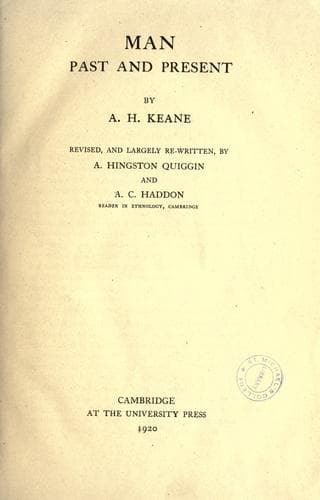
Man, Past and PresentKeane, A. H. (Augustus Henry)
History
Man, Past and Present
Keane, A. H. (Augustus Henry)
Anthropology; Ethnology
On the north-eastern border the Plains-Ojibway and Plains-Cree combine
many traits of the forest hunting tribes with those found in the Plains.
The Dakota or Sioux are universally conceded to be of the highest type,
physically, mentally and probably morally of any of the western tribes.
Their bravery has never been questioned by white or Indian and they
conquered or drove out every rival except the Ojibway. Their physical
characteristics are as follows: dark skin faintly tinged with red,
facial features more strongly marked than those of the Pacific Coast
Indians, nose and lower jaw particularly prominent and heavy, head
generally mesocephalic and not artificially deformed. They are a free
and dominant race of hunters and warriors, necessarily strong and
active. Their weapons of stone, wood, bone and horn are tomahawk, club,
flint knife, and bow and arrow. All their habits centre in the bison,
which provided the staple materials of nutrition and industry. Drawing
and painting were done on prepared bison skins and elaborately carved
pipes were made for ceremonial use.
They are divided into kinship groups, with inheritance as a rule in the
male line. The woman is autocrat of the home. Exogamy was strictly
enforced in the clan but marriage within the tribe or with related
tribes was encouraged. The marriage was arranged by the parents and
polygyny was common where means would permit. Government consisted in
chieftainship acquired by personal merit, and the old men exercised
considerable influence.
Religious conceptions were based on a belief in _Wakonda_ or
_Manito_[834], an all-pervading spirit force, whose cult involved
various shamanistic ceremonials consisting of dancing, chanting,
feasting and fasting. Most distinctive of these is the Sun dance,
practised by almost all the tribes of the plains except the Comanche. It
is an annual festival lasting several days, in honour of the sun, for
the purpose of obtaining abundant produce throughout the year.
The Sun dance was not only the greatest ceremony of the Plains tribes
but was a condition of their existence. More than any other ceremony or
occasion, it furnished the tribe the opportunity for the expression of
emotion in rhythm, and was the occasion of the tribe becoming more
closely united. It gave opportunity for the making and renewing of
common interests, the inauguration of tribal policies, and the renewing
of the rank of the chiefs; for the exhibition, by means of mourning
feasts, of grief over the loss of members of families; for the
fulfilment of social obligations by means of feasts; and, finally, for
the exercise and gratification of the emotions of love on the part of
the young in the various social dances which always formed an
interesting feature of the ceremony[835].
Public-domain text, read in full here on John Shaqi.
Reviews
Reviews
No reviews yet
Be the first to share your thoughts on this work.
Elsewhere in the archive
Join the Discussion
Join the discussion
Sign in to leave a comment or review.
Sign InorCreate an account