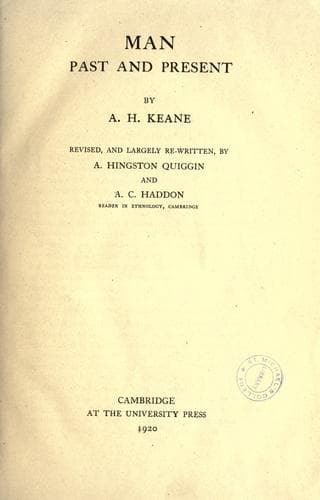
Man, Past and PresentKeane, A. H. (Augustus Henry)
History
Man, Past and Present
Keane, A. H. (Augustus Henry)
Anthropology; Ethnology
There remain the north-eastern Hamites, and especially the Galla branch,
as the essential extraneous factor in this obscure Bantu problem. To the
stream of migration described by M. Clozel as setting east and west,
corresponds another and an older stream, which ages ago took a southerly
direction along the eastern seaboard to the extremity of the continent,
where are now settled the Zulu-Xosa nations, almost more Hamites than
Negroes.
The impulse to two such divergent movements could have come only from
the north-east, where we still find the same tendencies in actual
operation. During his exploration of the east equatorial lands, Capt.
Speke had already observed that the rulers of the Bantu nations about
the Great Lakes (Karagwe, Ba-Ganda, Ba-Nyoro, etc.) all belonged to the
same race, known by the name of _Ba-Hima_, that is, "Northmen," a
pastoral people of fine appearance, who were evidently of Galla stock,
and had come originally from Gallaland. Since then Schuver found that
the Negroes of the Afilo country are governed by a Galla
aristocracy[230], and we now know that several Ba-hima communities
bearing different names live interspersed amongst the mixed Bantu
nations of the lacustrian plateaux as far south as Lake Tanganyika and
Unyamweziland[231]. Here the Wa-Tusi, Wa-Hha, and Wa-Ruanda are or were
all of the same Hamitic type, and M. Lionel Decle "was very much struck
by the extraordinary difference that is to be found between them and
their Bantu neighbours[232]." Then this observer adds: "Pure types are
not common, and are only to be found amongst the aristocracy, if I may
use such an expression for Africans. The mass of the people have lost
their original type through intermixture with neighbouring tribes."
J. Roscoe[233] thus describes the inhabitants of Ankole. "The pastoral
people are commonly called Bahima, though they prefer to be called
Banyankole; they are a tall fine race though physically not very strong.
Many of them are over six feet in height, their young king being six
feet six inches and broad in proportion to his height.... It is not only
the men who are so tall, the women also being above the usual stature of
their sex among other tribes, though they do injustice to their height
by a fashionable stoop which makes them appear much shorter than they
really are. The features of these pastoral people are good: they have
straight noses with a bridge, thin lips, finely chiselled faces, heads
well set on fairly developed frames, and a good carriage; there is in
fact nothing but their colour and their short woolly hair to make you
think of them as negroids."
Public-domain text, read in full here on John Shaqi.
Reviews
Reviews
No reviews yet
Be the first to share your thoughts on this work.
Elsewhere in the archive
Join the Discussion
Join the discussion
Sign in to leave a comment or review.
Sign InorCreate an account