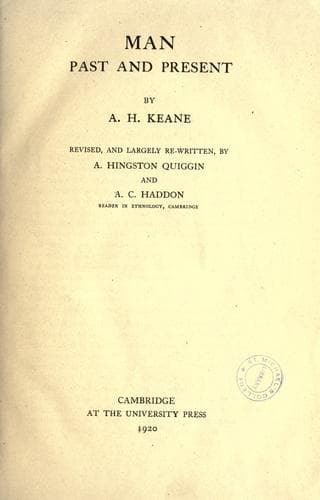
Man, Past and PresentKeane, A. H. (Augustus Henry)
History
Man, Past and Present
Keane, A. H. (Augustus Henry)
Anthropology; Ethnology
The contrast and the relationship between the pastoral conquerors and
the agricultural tribes is clearly seen among the Ba-Nyoro. "The
pastoral people are a tall, well-built race of men and women with finely
cut features, many of them over six feet in height. The men are athletic
with little spare flesh, but the women are frequently very fat and
corpulent: indeed their ideal of beauty is obesity, and their milk diet
together with their careful avoidance of exercise tends to increase
their size. The agricultural clans, on the other hand, are short,
ill-favoured looking men and women with broad noses of the negro type,
lean and unkempt. Both classes are dark, varying in shade from a light
brown to deep black, with short woolly hair. The pastoral people
refrain, as far as possible, from all manual labour and expect the
agricultural clans to do their menial work for them, such as building
their houses, carrying firewood and water, and supplying them with grain
and beer for their households." "Careful observation and enquiry lead to
the opinion that the agricultural clans were the original inhabitants
and that they were conquered by the pastoral people who have reduced
them to their present servile condition[234]."
From these indications and many others that might easily be adduced, it
may be concluded with some confidence that the great mass of the Bantu
populations are essentially Negroes, leavened in diverse proportions,
for the most part by conquering Galla or Hamitic elements percolating
for thousands of generations from the north-eastern section of the
Hamitic domain into the heart of Bantuland.
Public-domain text, read in full here on John Shaqi.
Reviews
Reviews
No reviews yet
Be the first to share your thoughts on this work.
Elsewhere in the archive
Join the Discussion
Join the discussion
Sign in to leave a comment or review.
Sign InorCreate an account