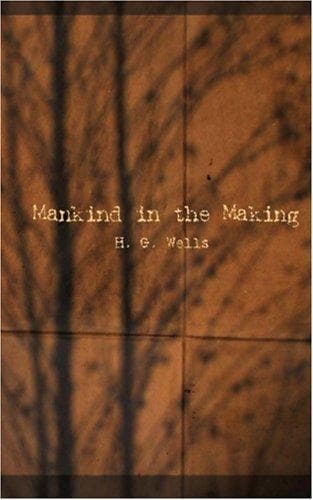
Mankind in the MakingWells, H. G. (Herbert George)
Philosophy
Mankind in the Making
Wells, H. G. (Herbert George)
Social problems; Social sciences
Let us take, first of all, the question of the reconciliation as it is
presented in the administration of public affairs. The days have come
when the most democratic-minded of men must begin to admit that the
appointment of all rulers and officials by polling the manhood, or most
of the manhood, of a country does not work--let us say perfectly--and at
no level of educational efficiency does it ever seem likely to work in
the way those who established it hoped. By thousands of the most varied
experiments the nineteenth century has proved this up to the hilt. The
fact that elections can only be worked as a choice between two selected
candidates, or groups of candidates, is the unforeseen and unavoidable
mechanical defect of all electoral methods with large electorates.
Education has nothing to do with that. The elections for the English
University members are manipulated just as much as the elections in the
least literate of the Irish constituencies. [Footnote: There is a very
suggestive book on this aspect of our general question, _The Crowd_, by
M. Gustave le Bon, which should interest any one who finds this paper
interesting. And the English reader who would like a fuller treatment
of this question has now available also Ostrogorski’s great work,
_Democracy and the Organization of Political Parties_.] It is not a
question of accidentals, but a question of the essential mechanism. Men
have sought out and considered all sorts of devices for qualifying the
present method by polling; Mills’s plural voting for educated men will
occur to the reader; Hare’s system of vote collection, and the negative
voting of Doctor Grece; and the defects of these inventions have been
sufficiently obvious to prevent even a trial. The changes have been
rung upon methods of counting; cumulative votes and the prohibition of
plumping, and so on, have been tried without any essential modification
of the results. There are various devices for introducing “stages” in
the electoral process; the constituency elects electors, who elect the
rulers and officers, for example, and there is also that futile attempt
to bring in the non-political specialist, the method of electing
governing bodies with power to “co-opt.” Of course they “co-opt”
their fellow politicians, rejected candidates, and so on. Among other
expedients that people have discussed, are such as would make it
necessary for a man to take some trouble and display some foresight to
get registered as a voter or to pass an examination to that end, and
such as would confront him with a voting paper so complex, that only a
very intelligent and painstaking man would be able to fill it up without
disqualification. It certainly seems a reasonable thing to require that
the voter should be able at least to write out fully and spell correctly
the name of the man of his choice. Except for the last, there is
scarcely any of these things but its adoption would strengthen the power
Public-domain text, read in full here on John Shaqi.
Reviews
Reviews
No reviews yet
Be the first to share your thoughts on this work.
Elsewhere in the archive
Join the Discussion
Join the discussion
Sign in to leave a comment or review.
Sign InorCreate an account