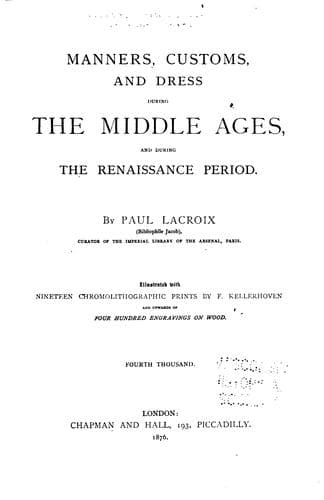
Manners, Customs, and Dress During the Middle Ages and During the Renaissance PeriodJacob, P. L.
History
Manners, Customs, and Dress During the Middle Ages and During the Renaissance Period
Jacob, P. L.
Clothing and dress; Manners and customs; Middle Ages; Renaissance
"Lever à six, dîner à dix,
Souper à six, coucher à dix,
Fait vivre l'homme dix fois dix."
("To rise at six, dine at ten,
Sup at six, to bed at ten,
Makes man live ten times ten.")
[Illustration: Fig. 131.--Banner of the Corporation of Pastrycooks of
Tonnerre.]
Hunting.
Venery and Hawking.--Origin of Aix-la-Chapelle.--Gaston Phoebus and his
Book.--The Presiding Deities of Sportsmen.--Sporting Societies and
Brotherhoods.--Sporting Kings: Charlemagne, Louis IX., Louis XI.,
Charles VIII., Louis XII., Francis I., &c.--Treatise on
Venery.--Sporting Popes.--Origin of Hawking.--Training Birds.--Hawking
Retinues.--Book of King Modus.--Technical Terms used in
Hawking.--Persons who have excelled in this kind of Sport.--Fowling.
By the general term hunting is included the three distinct branches of an
art, or it may be called a science, which dates its origin from the
earliest times, but which was particularly esteemed in the Middle Ages,
and was especially cultivated in the glorious days of chivalry.
_Venery_, which is the earliest, is defined by M. Elzéar Blaze as "the
science of snaring, taking, or killing one particular animal from amongst
a herd." _Hawking_ came next. This was not only the art of hunting with
the falcon, but that of training birds of prey to hunt feathered game.
Lastly, _l'oisellerie_ (fowling), which, according to the author of
several well-known works on the subject we are discussing, had originally
no other object than that of protecting the crops and fruits from birds
and other animals whose nature it was to feed on them.
Venery will be first considered. Sportsmen always pride themselves in
placing Xenophon, the general, philosopher, and historian, at the head of
sporting writers, although his treatise on the chase (translated from the
Greek into Latin under the title of "De Venatione"), which gives excellent
advice respecting the training of dogs, only speaks of traps and nets for
capturing wild animals. Amongst the Greeks Arrian and Oppian, and amongst
the Romans, Gratius Faliscus and Nemesianus, wrote on the same subject.
Their works, however, except in a few isolated or scattered passages, do
not contain anything about venery properly so called, and the first
historical information on the subject is to be found in the records of the
seventh century.
Long after that period, however, they still hunted, as it were, at random,
attacking the first animal they met. The sports of Charlemagne, for
instance, were almost always of this description. On some occasions they
killed animals of all sorts by thousands, after having tracked and driven
them into an enclosure composed of cloths or nets.
Public-domain text, read in full here on John Shaqi.
Reviews
Reviews
No reviews yet
Be the first to share your thoughts on this work.
Elsewhere in the archive
Join the Discussion
Join the discussion
Sign in to leave a comment or review.
Sign InorCreate an account