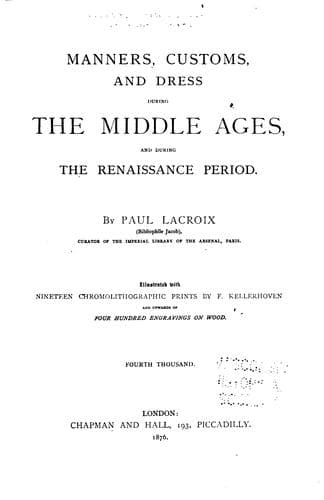
Manners, Customs, and Dress During the Middle Ages and During the Renaissance PeriodJacob, P. L.
History
Manners, Customs, and Dress During the Middle Ages and During the Renaissance Period
Jacob, P. L.
Clothing and dress; Manners and customs; Middle Ages; Renaissance
It was during this reign that some ingenious person discovered that the
words LOUIS TREIZIÈME, ROY DE FRANCE ET DE NAVARRE, exactly gave this
anagram, ROY TRÈS-RARE, ESTIMÉ DIEU DE LA FAUCONNERIE. It was also at this
time that Charles d'Arcussia, the last author who wrote a technical work
on falconry, after praising his majesty for devoting himself so thoroughly
to the divine sport, compared the King's birds to domestic angels, and the
carnivorous birds which they destroyed he likened to the devil. From this
he argued that the sport was like the angel Gabriel destroying the demon
Asmodeus. He also added, in his dedication to the King, "As the nature of
angels is above that of men, so is that of these birds above all other
animals."
[Illustration: Fig. 156.--Dress of the Falconer (Thirteenth
Century).--Sculpture of the Cathedral of Rouen.]
At that time certain religious or rather superstitious ceremonies were in
use for blessing the water with which the falcons were sprinkled before
hunting, and supplications were addressed to the eagles that they might
not molest them. The following words were used: "I adjure you, O eagles!
by the true God, by the holy God, by the most blessed Virgin Mary, by the
nine orders of angels, by the holy prophets, by the twelve apostles,
&c.... to leave the field clear to our birds, and not to molest them: in
the name of the Father, and of the Son, and of the Holy Ghost." It was at
this time that, in order to recover a lost bird, the Sire de la
Brizardière, a professional necromancer, proposed beating the owner of the
bird with birch-rods until he bled, and of making a charm with the blood,
which was reckoned infallible.
[Illustration: Fig. 157.--Diseases of Dogs and their Cure.--Fac-simile of
a Miniature in the Manuscript of Phoebus (Fourteenth Century).]
Elzéar Blaze expressed his astonishment that the ladies should not have
used their influence to prevent falconry from falling into disuse. The
chase, he considered, gave them an active part in an interesting and
animated scene, which only required easy and graceful movements on their
part, and to which no danger was attached. "The ladies knowing," he says,
"how to fly a bird, how to call him back, and how to encourage him with
their voice, being familiar with him from having continually carried him
on their wrist, and often even from having broken him in themselves, the
honour of hunting belongs to them by right. Besides, it brings out to
advantage their grace and dexterity as they gallop amongst the sportsmen,
followed by their pages and varlets and a whole herd of horses and dogs."
Public-domain text, read in full here on John Shaqi.
Reviews
Reviews
No reviews yet
Be the first to share your thoughts on this work.
Elsewhere in the archive
Join the Discussion
Join the discussion
Sign in to leave a comment or review.
Sign InorCreate an account