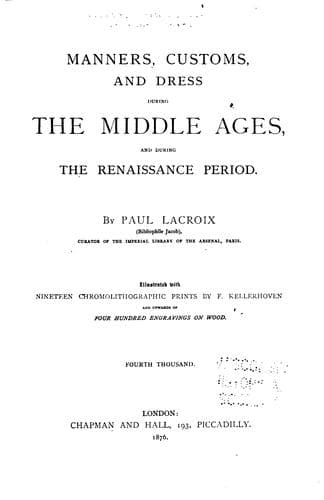
Manners, Customs, and Dress During the Middle Ages and During the Renaissance PeriodJacob, P. L.
History
Manners, Customs, and Dress During the Middle Ages and During the Renaissance Period
Jacob, P. L.
Clothing and dress; Manners and customs; Middle Ages; Renaissance
It is satisfactory to observe that at that period measures were taken to
preserve nests and to prevent bird-fowling from the 15th of March to the
15th of August. Besides this, it was necessary to have an express
permission from the King himself to give persons the right of catching
birds on the King's domains. Before any one could sell birds it was
required for him to have been received as a master bird-catcher. The
recognised bird-catchers, therefore, had no opponents except dealers from
other countries, who brought canary-birds, parrots, and other foreign
specimens into Paris. These dealers were, however, obliged to conform to
strict rules. They were required on their arrival to exhibit their birds
from ten to twelve o'clock on the marble stone in the palace yard on the
days when parliament sat, in order that the masters and governors of the
King's aviary, and, after them, the presidents and councillors, might have
the first choice before other people of anything they wished to buy. They
were, besides, bound to part the male and female birds in separate cages
with tickets on them, so that purchasers might not be deceived; and, in
case of dispute on this point, some sworn inspectors were appointed as
arbitrators.
No doubt, emboldened by the victory which they had achieved over the
goldsmiths of the Pont an Change, the bird-dealers of Paris attempted to
forbid any bourgeois of the town from breeding canaries or any sort of
cage birds. The bourgeois resented this, and brought their case before the
Marshals of France. They urged that it was easy for them to breed
canaries, and it was also a pleasure for their wives and daughters to
teach them, whereas those bought on the Pont an Change were old and
difficult to educate. This appeal was favourably received, and an order
from the tribunal of the Marshals of France permitted the bourgeois to
breed canaries, but it forbade the sale of them, which it was considered
would interfere with the trade of the master-fowlers of the town,
faubourgs, and suburbs of Paris.
[Illustration: Fig. 165.--Powder-horn.--Work of the Sixteenth Century
(Artillery Museum of Brussels).]
Games and Pastimes.
Games of the Ancient Greeks and Romans.--Games of the Circus.--Animal
Combats.--Daring of King Pepin.--The King's Lions.--Blind Men's
Fights.--Cockneys of Paris.--Champ de Mars.--Cours Plénières and Cours
Couronnées.--Jugglers, Tumblers, and
Minstrels.--Rope-dancers.--Fireworks.--Gymnastics.--Cards and
Dice.--Chess, Marbles, and Billiards.--La Soule, La Pirouette,
&c.--Small Games for Private Society.--History of Dancing.--Ballet des
Ardents.--The "Orchésographie" (Art of Dancing) of Thoinot Arbeau.--List
of Dances.
Public-domain text, read in full here on John Shaqi.
Reviews
Reviews
No reviews yet
Be the first to share your thoughts on this work.
Elsewhere in the archive
Join the Discussion
Join the discussion
Sign in to leave a comment or review.
Sign InorCreate an account