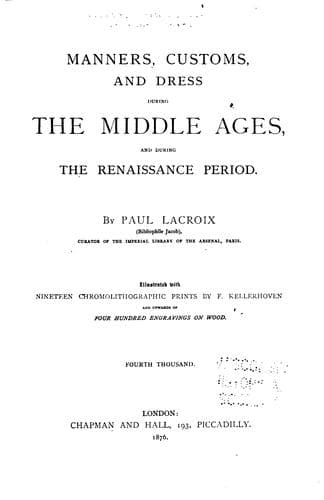
Manners, Customs, and Dress During the Middle Ages and During the Renaissance PeriodJacob, P. L.
History
Manners, Customs, and Dress During the Middle Ages and During the Renaissance Period
Jacob, P. L.
Clothing and dress; Manners and customs; Middle Ages; Renaissance
Under the powerful and administrative hand of Charlemagne, the roads being
better kept up, and the rivers being made more navigable, commerce became
safe and more general; the coasts were protected from piratical
incursions; lighthouses were erected at dangerous points, to prevent
shipwrecks; and treaties of commerce with foreign nations, including even
the most distant, guaranteed the liberty and security of French traders
abroad.
Under the weak successors of this monarch, notwithstanding their many
efforts, commerce was again subjected to all sorts of injustice and
extortions, and all its safeguards were rapidly destroyed. The Moors in
the south, and the Normans in the north, appeared to desire to destroy
everything which came in their way, and already Marseilles, in 838, was
taken and pillaged by the Greeks. The constant altercations between the
sons of Louis le Débonnaire and their unfortunate father, their jealousies
amongst themselves, and their fratricidal wars, increased the measure of
public calamity, so that soon, overrun by foreign enemies and destroyed by
her own sons, France became a vast field of disorder and desolation.
The Church, which alone possessed some social influence, never ceased to
use its authority in endeavouring to remedy this miserable state of
things; but episcopal edicts, papal anathemas, and decrees of councils,
had only a partial effect at this unhappy period. At any moment
agricultural and commercial operations were liable to be interrupted, if
not completely ruined, by the violence of a wild and rapacious soldiery;
at every step the roads, often impassable, were intercepted by toll-bars
for some due of a vexatious nature, besides being continually infested by
bands of brigands, who carried off the merchandise and murdered those few
merchants who were so bold as to attempt to continue their business. It
was the Church, occupied as she was with the interests of civilisation,
who again assisted commerce to emerge from the state of annihilation into
which it had fallen; and the "Peace or Truce of God," established in 1041,
endeavoured to stop at least the internal wars of feudalism, and it
succeeded, at any rate for a time, in arresting these disorders. This was
all that could be done at that period, and the Church accomplished it, by
taking the high hand; and with as much unselfishness as energy and
courage, she regulated society, which had been abandoned by the civil
power from sheer impotence and want of administrative capability.
[Illustration: Fig. 191.--Trade on the Seaports of the Levant.--After a
Miniature in a Manuscript of the Travels of Marco Polo (Fifteenth
Century), Library of the Arsenal of Paris.]
Public-domain text, read in full here on John Shaqi.
Reviews
Reviews
No reviews yet
Be the first to share your thoughts on this work.
Elsewhere in the archive
Join the Discussion
Join the discussion
Sign in to leave a comment or review.
Sign InorCreate an account