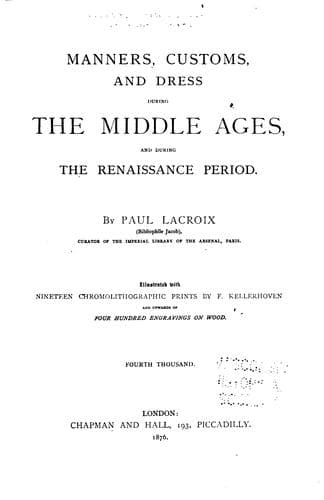
Manners, Customs, and Dress During the Middle Ages and During the Renaissance PeriodJacob, P. L.
History
Manners, Customs, and Dress During the Middle Ages and During the Renaissance Period
Jacob, P. L.
Clothing and dress; Manners and customs; Middle Ages; Renaissance
More important than the woollen manufactures--for the greater part of the
wool used was brought from England--was the manufacture of flax, inasmuch
as it encouraged agriculture, the raw material being produced in France.
This first flourished in the north-east of France, and spread slowly to
Picardy, to Beauvois, and Brittany. The central countries, with the
exception of Bruges, whose cloth manufactories were already celebrated in
the fifteenth century, remained essentially agricultural; and their
principal towns were merely depôts for imported goods. The institution of
fairs, however, rendered, it is true, this commerce of some of the towns
as wide-spread as it was productive. In the Middle Ages religious feasts
and ceremonials almost always gave rise to fairs, which commerce was not
slow in multiplying as much as possible. The merchants naturally came to
exhibit their goods where the largest concourse of people afforded the
greatest promise of their readily disposing of them. As early as the first
dynasty of Merovingian kings, temporary and periodical markets of this
kind existed; but, except at St. Denis, articles of local consumption only
were brought to them. The reasons for this were, the heavy taxes which
were levied by the feudal lords on all merchandise exhibited for sale, and
the danger which foreign merchants ran of being plundered on their way, or
even at the fair itself. These causes for a long time delayed the progress
of an institution which was afterwards destined to become so useful and
beneficial to all classes of the community.
We have several times mentioned the famous fair of Landit, which is
supposed to have been established by Charlemagne, but which no doubt was a
sort of revival of the fairs of St. Denis, founded by Dagobert, and which
for a time had fallen into disuse in the midst of the general ruin which
preceded that emperor's reign. This fair of Landit was renowned over the
whole of Europe, and attracted merchants from all countries. It was held
in the month of June, and only lasted fifteen days. Goods of all sorts,
both of home and foreign manufacture, were sold, but the sale of parchment
was the principal object of the fair, to purchase a supply of which the
University of Paris regularly went in procession. On account of its
special character, this fair was of less general importance than the six
others, which from the twelfth century were held at Troyes, Provins,
Lagny-sur-Marne, Rheims, and Bar-sur-Aube. These infused so much
commercial vitality into the province of Champagne, that the nobles for
the most part shook off the prejudice which forbad their entering into any
sort of trading association.
Public-domain text, read in full here on John Shaqi.
Reviews
Reviews
No reviews yet
Be the first to share your thoughts on this work.
Elsewhere in the archive
Join the Discussion
Join the discussion
Sign in to leave a comment or review.
Sign InorCreate an account