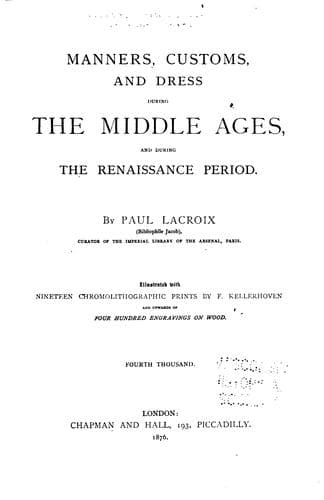
Manners, Customs, and Dress During the Middle Ages and During the Renaissance PeriodJacob, P. L.
History
Manners, Customs, and Dress During the Middle Ages and During the Renaissance Period
Jacob, P. L.
Clothing and dress; Manners and customs; Middle Ages; Renaissance
Philippe le Bel issued several prohibitory enactments also in the interest
of home commerce and local industry, which Louis X. confirmed. Philippe le
Long attempted even to outdo the judicious efforts of Louis XI., and
tried, though unsuccessfully, to establish a uniformity in the weights and
measures throughout the kingdom; a reform, however, which was never
accomplished until the revolution of 1789. It is difficult to credit how
many different weights and measures were in use at that time, each one
varying according to local custom or the choice of the lord of the soil,
who probably in some way profited by the confusion which this uncertain
state of things must have produced. The fraud and errors to which this led
may easily be imagined, particularly in the intercourse between one part
of the country and another. The feudal stamp is here thoroughly exhibited;
as M. Charles de Grandmaison remarks, "Nothing is fixed, nothing is
uniform, everything is special and arbitrary, settled by the lord of the
soil by virtue of his right of _justesse_, by which he undertook the
regulation and superintendence of the weights and measures in use in his
lordship."
Measures of length and contents often differed much from one another,
although they might be similarly named, and it would require very
complicated comparative tables approximately to fix their value. The _pied
de roi_ was from ten to twelve inches, and was the least varying measure.
The fathom differed much in different parts, and in the attempt to
determine the relations between the innumerable measures of contents which
we find recorded--a knowledge of which must have been necessary for the
commerce of the period--we are stopped by a labyrinth of incomprehensible
calculations, which it is impossible to determine with any degree of
certainty.
The weights were more uniform and less uncertain. The pound was everywhere
in use, but it was not everywhere of the same standard (Fig. 201). For
instance, at Paris it weighed sixteen ounces, whereas at Lyons it only
weighed fourteen; and in weighing silk fifteen ounces to the pound was
the rule. At Toulouse and in Upper Languedoc the pound was only thirteen
and a half ounces; at Marseilles, thirteen ounces; and at other places it
even fell to twelve ounces. There was in Paris a public scale called
_poids du roi_; but this scale, though a most important means of revenue,
was a great hindrance to retail trade.
In spite of these petty and irritating impediments, the commerce of France
extended throughout the whole world.
[Illustration: Fig. 197.--View of Lubeck and its Harbour (Sixteenth
Century).--From a Copper-plate in the Work of P. Bertius, "Commentaria
Rerum Germanicarum," in 4to: Amsterdam, 1616.]
Public-domain text, read in full here on John Shaqi.
Reviews
Reviews
No reviews yet
Be the first to share your thoughts on this work.
Elsewhere in the archive
Join the Discussion
Join the discussion
Sign in to leave a comment or review.
Sign InorCreate an account