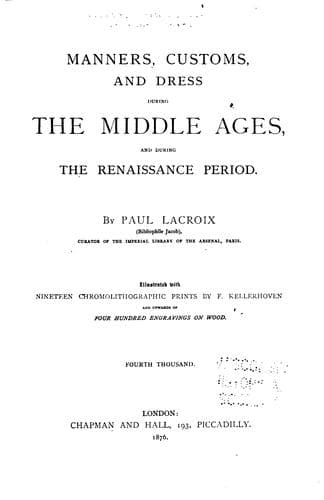
Manners, Customs, and Dress During the Middle Ages and During the Renaissance PeriodJacob, P. L.
History
Manners, Customs, and Dress During the Middle Ages and During the Renaissance Period
Jacob, P. L.
Clothing and dress; Manners and customs; Middle Ages; Renaissance
Indeed, brotherhoods amongst the labouring classes always existed under
the German conquerors from the moment when Europe, so long divided into
Roman provinces, shook off the yoke of subjection to Rome, although she
still adhered to the laws and customs of the nation which had held her in
subjection for so many generations. We can, however, only regard the few
traces which remain of these brotherhoods as evidence of their having
once existed, and not as indicative of their having been in a flourishing
state. In the fifth century, the Hermit Ampelius, in his "Legends of the
Saints," mentions _Consuls_ or Chiefs of Locksmiths. The Corporation of
Goldsmiths is spoken of as existing in the first dynasty of the French
kings. Bakers are named collectively in 630 in the laws of Dagobert, which
seems to show that they formed a sort of trade union at that remote
period. We also see Charlemagne, in several of his statutes, taking steps
in order that the number of persons engaged in providing food of different
kinds should everywhere be adequate to provide for the necessities of
consumption, which would tend to show a general organization of that most
important branch of industry. In Lombardy colleges of artisans were
established at an early period, and were, no doubt, on the model of the
Roman ones. Ravenna, in 943, possessed a College of Fishermen; and ten
years later the records of that town mention a _Chief of the Corporation
of Traders_, and, in 1001, a _Chief of the Corporation of Butchers_.
France at the same time kept up a remembrance of the institutions of Roman
Gaul, and the ancient colleges of trades still formed associations and
companies in Paris and in the larger towns. In 1061 King Philip I. granted
certain privileges to Master Chandlers and Oilmen. The ancient customs of
the butchers are mentioned as early as the time of Louis VII., 1162. The
same king granted to the wife of Ives Laccobre and her heirs the
collectorship of the dues which were payable by tanners, purse-makers,
curriers, and shoemakers. Under Philip Augustus similar concessions became
more frequent, and it is evident that at that time trade was beginning to
take root and to require special and particular administration. This led
to regulations being drawn up for each trade, to which Philip Augustus
gave his sanction. In 1182 he confirmed the statutes of the butchers, and
the furriers and drapers also obtained favourable concessions from him.
Public-domain text, read in full here on John Shaqi.
Reviews
Reviews
No reviews yet
Be the first to share your thoughts on this work.
Elsewhere in the archive
Join the Discussion
Join the discussion
Sign in to leave a comment or review.
Sign InorCreate an account