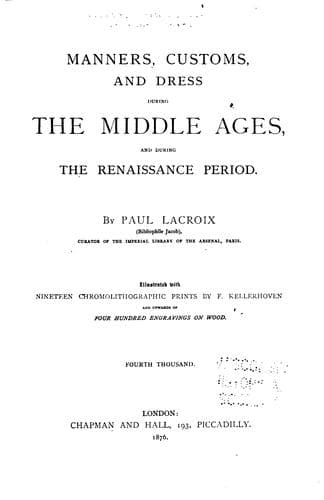
Manners, Customs, and Dress During the Middle Ages and During the Renaissance PeriodJacob, P. L.
History
Manners, Customs, and Dress During the Middle Ages and During the Renaissance Period
Jacob, P. L.
Clothing and dress; Manners and customs; Middle Ages; Renaissance
In fact in this, as in many other matters, social disorder often emanated
from the powers whose duty it was in the first instance to have repressed
it. Thus, at the time when Philip Augustus extended the boundaries of his
capital so as to include the boroughs in it, which until then had been
separated from the city, the lay and clerical lords, under whose feudal
dominion those districts had hitherto been placed, naturally insisted upon
preserving all their rights. So forcibly did they do this that the King
was obliged to recognise their claims; and in several boroughs, including
the Bourg l'Abbé, the Beau Bourg, the Bourg St. Germain, and the Bourg
Auxerrois, &c., there were trade associations completely distinct from and
independent of those of ancient Paris. If we simply limit our examination
to that of the condition of the trade associations which held their
authority immediately from royalty, we still see that the causes of
confusion were by no means trifling; for the majority of the high officers
of the crown, acting as delegates of the royal authority, were always
disputing amongst themselves the right of superintending, protecting,
judging, punishing, and, above all, of exacting tribute from the members
of the various trades. The King granted to various officers the privilege
of arbitrarily disposing of the freedom of each trade for their own
profit, and thereby gave them power over all the merchants and craftsmen
who were officially connected with them, not only in Paris, but also
throughout the whole kingdom. Thus the lord chamberlain had jurisdiction
over the drapers, mercers, furriers, shoemakers, tailors, and other
dealers in articles of wearing apparel; the barbers were governed by the
king's varlet and barber; the head baker was governor over the bakers; and
the head butler over the wine merchants.
[Illustration: Fig. 234.--Group of Goldsmiths preceding the _Chasse de St.
Marcel_ in the Reign of Louis XIII.--From a Copper-plate of the Period
(Cabinet of Stamps in the National Library of Paris).]
These state officers granted freedoms to artisans, or, in other words,
they gave them the right to exercise such and such a craft with assistants
or companions, exacting for the performance of this trifling act a very
considerable tax. And, as they preferred receiving their revenues without
the annoyance of having direct communication with their humble subjects,
they appointed deputies, who were authorised to collect them in their
names.
The most celebrated of these deputies were the _rois des merciers_, who
lived on the fat of the land in complete idleness, and who were surrounded
by a mercantile court, which appeared in all its splendour at the trade
festivals.
[Illustration: Fig. 235.--Banner of the Corporation of the United Boot and
Shoe Makers of Issoudun.]
Public-domain text, read in full here on John Shaqi.
Reviews
Reviews
No reviews yet
Be the first to share your thoughts on this work.
Elsewhere in the archive
Join the Discussion
Join the discussion
Sign in to leave a comment or review.
Sign InorCreate an account