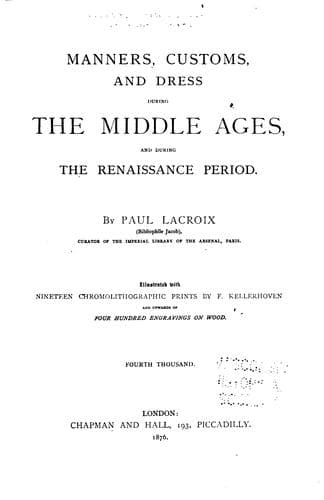
Manners, Customs, and Dress During the Middle Ages and During the Renaissance PeriodJacob, P. L.
History
Manners, Customs, and Dress During the Middle Ages and During the Renaissance Period
Jacob, P. L.
Clothing and dress; Manners and customs; Middle Ages; Renaissance
The jurors, or syndics, as they were more usually called, and whose number
varied according to the importance of numerical force of the corporation,
were generally elected by the majority of votes of their fellow-workmen,
though sometimes the choice of these was entirely in the hands of the
great officers of state. It was not unfrequent to find women amongst the
dignitaries of the arts and crafts; and the professional tribunals, which
decided every question relative to the community and its members, were
often held by an equal number of masters and associate craftsmen. The
jealous, exclusive, and inflexible spirit of caste, which in the Middle
Ages is to be seen almost everywhere, formed one of the principal features
of industrial associations. The admission of new members was surrounded
with conditions calculated to restrict the number of associates and to
discourage candidates. The sons of masters alone enjoyed hereditary
privileges, in consequence of which they were always allowed to be
admitted without being subjected to the tyrannical yoke of the
association.
[Illustration: Martyrdom of SS. Crispin and Crépinien.
From a window in the Hôpital des Quinze-Vingts (Fifteenth Century).]
Generally the members of a corporation were divided into three distinct
classes--the masters, the paid assistants or companions, and the
apprentices. Apprenticeship, from which the sons of masters were often
exempted, began between the ages of twelve and seventeen years, and
lasted from two to five years. In most of the trades the master could only
receive one apprentice in his house besides his own son. Tanners, dyers,
and goldsmiths were allowed one of their relatives in addition, or a
second apprentice if they had no relation willing to learn their trade;
and although some commoner trades, such as butchers and bakers, were
allowed an unlimited number of apprentices, the custom of restriction had
become a sort of general law, with the object of limiting the number of
masters and workmen to the requirements of the public. The position of
paid assistant or companion was required to be held in many trades for a
certain length of time before promotion to mastership could be obtained.
[Illustration: Fig. 243.--Bootmaker's Apprentice working at a
Trial-piece.--From a Window of the Thirteenth Century, published by
Messrs. Cahier and Martin]
Public-domain text, read in full here on John Shaqi.
Reviews
Reviews
No reviews yet
Be the first to share your thoughts on this work.
Elsewhere in the archive
Join the Discussion
Join the discussion
Sign in to leave a comment or review.
Sign InorCreate an account