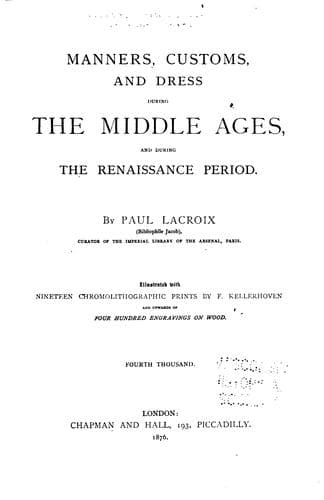
Manners, Customs, and Dress During the Middle Ages and During the Renaissance PeriodJacob, P. L.
History
Manners, Customs, and Dress During the Middle Ages and During the Renaissance Period
Jacob, P. L.
Clothing and dress; Manners and customs; Middle Ages; Renaissance
Besides taking various steps to maintain professional integrity, the
framers of the various statutes, as a safeguard to the public interests,
undertook also to inculcate morality and good feeling amongst their
members. A youth could not be admitted unless he could prove his
legitimacy of birth by his baptismal register; and, to obtain the freedom,
he was bound to bear an irreproachable character. Artisans exposed
themselves to a reprimand, and even to bodily chastisement, from the
corporation, for even associating with, and certainly for working or
drinking with those who had been expelled. Licentiousness and misconduct
of any kind rendered them liable to be deprived of their mastership. In
some trade associations all the members were bound to solemnize the day of
the decease of a brother, to assist at his funeral, and to follow him to
the grave. In another community the slightest indecent or discourteous
word was punishable by a fine. A new master could not establish himself in
the same street as his former master, except at a distance, which was
determined by the statutes; and, further, no member was allowed to ask for
or attract customers when the latter were nearer the shop of his neighbour
than of his own.
In the Middle Ages religion placed its stamp on every occupation and
calling, and corporations were careful to maintain this characteristic
feature. Each was under the patronage of some saint, who was considered
the special protector of the craft; each possessed a shrine or chapel in
some church of the quarter where the trade was located, and some even kept
chaplains at their own expense for the celebration of masses which were
daily said for the souls of the good deceased members of the craft. These
associations, animated by Christian charity, took upon them to invoke the
blessings of heaven on all members of the fraternity, and to assist those
who were either laid by through sickness or want of work, and to take care
of the widows and to help the orphans of the less prosperous craftsmen.
They also gave alms to the poor, and presented the broken meat left at
their banquets to the hospitals.
Public-domain text, read in full here on John Shaqi.
Reviews
Reviews
No reviews yet
Be the first to share your thoughts on this work.
Elsewhere in the archive
Join the Discussion
Join the discussion
Sign in to leave a comment or review.
Sign InorCreate an account