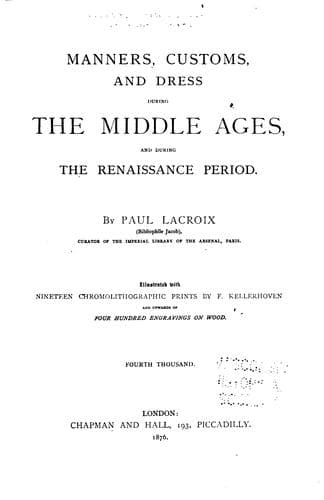
Manners, Customs, and Dress During the Middle Ages and During the Renaissance PeriodJacob, P. L.
History
Manners, Customs, and Dress During the Middle Ages and During the Renaissance Period
Jacob, P. L.
Clothing and dress; Manners and customs; Middle Ages; Renaissance
[Illustration: Merovingian Gold Coins, Struck by St. Eloy, Moneyer to
Dagobert I. (628-638).
Fig. 256.--Parisinna Ceve Fit.. Head of Dagobert with double diadem of
pearls, hair hanging down the back of the neck. _Rev._, Dagobertvs Rex.
Cross; above, omega; under the arms of the cross, Eligi.
Fig. 257.--Parissin. Civ. Head of Clovis II., with diadem of pearls, hair
braided and hanging down the back of the neck. _Rev._, Chlodovevs Rex.
Cross with anchor; under the arms of the cross, Eligi.
Fig. 258.--Parisivs Fit. Head of King. _Rev._, Eligivs Mone. Cross; above,
omega; under, a ball.
Fig. 259.--Mon. Palati. Head of King. _Rev._, Scolare. I. A. Cross with
anchor; under the arms of the cross, Eligi. ]
From the time that Clovis became a Christian, he loaded the Church with
favours, and it soon possessed considerable revenues, and enjoyed many
valuable immunities. The sons of Clovis contested these privileges; but
the Church resisted for a time, though she was eventually obliged to give
way to the iron hand of Charles Martel. In 732 this great military
chieftain, after his struggle with Rainfroy, and after his brilliant
victories over the Saxons, the Bavarians, the Swiss, and the Saracens,
stripped the clergy of their landed possessions, in order to distribute
them amongst his _Leudes_, who by this means he secured as his creatures,
and who were, therefore, ever willing and eager to serve him in arms.
On ascending the throne, King Pepin, who wanted to pacify the Church,
endeavoured as far as possible to obliterate the recollection of the
wrongs of which his father had been guilty towards her; he ordered the
_dîmes_ and the _nones_ (tenth and ninth denier levied on the value of
lands) to be placed to the account of the possessors of each
ecclesiastical domain, on their under-taking to repair the buildings
(churches, châteaux, abbeys, and presbyteries), and to restore to the
owners the properties on which they held mortgages. The nobles long
resented this, and it required the authority and the example of
Charlemagne to soothe the contending parties, and to make Church and State
act in harmony.
Public-domain text, read in full here on John Shaqi.
Reviews
Reviews
No reviews yet
Be the first to share your thoughts on this work.
Elsewhere in the archive
Join the Discussion
Join the discussion
Sign in to leave a comment or review.
Sign InorCreate an account