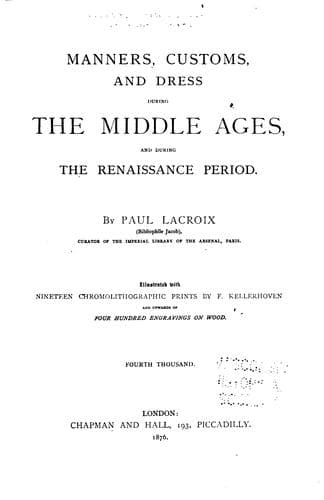
Manners, Customs, and Dress During the Middle Ages and During the Renaissance PeriodJacob, P. L.
History
Manners, Customs, and Dress During the Middle Ages and During the Renaissance Period
Jacob, P. L.
Clothing and dress; Manners and customs; Middle Ages; Renaissance
When Louis IX., in 1242, at Taillebourg and at Saintes, had defeated the
great vassals who had rebelled against him, he hastened to regulate the
taxes by means of a special code which bore the name of the
_Établissements_. The taxes thus imposed fell upon the whole population,
and even lands belonging to the Church, houses which the nobles did not
themselves occupy, rural properties and leased holdings, were all
subjected to them. There were, however, two different kinds of rates, one
called the _occupation_ rate, and the other the rate of _exploitation_;
and they were both collected according to a register, kept in the most
regular and systematic manner possible. Ancient custom had maintained a
tax exceptionally in the following cases: when a noble dubbed his son a
knight, or gave his daughter in marriage, when he had to pay a ransom,
and when he set out on a campaign against the enemies of the Church, or
for the defence of the country. These taxes were called _l'aide aux quatre
cas_. At this period despotism too often overruled custom, and the good
King Louis IX., by granting legal power to custom, tried to bring it back
to the true principles of justice and humanity. He was, however, none the
less jealous of his own personal privileges, especially as regarded
coining (Figs. 263 to 270). He insisted that coining should be exclusively
carried on in his palace, as in the times of the Carlovingian kings, and
he required every coin to be made of a definite standard of weight, which
he himself fixed. In this way he secured the exclusive control over the
mint. For the various localities, towns, or counties directly under the
crown, Louis IX. settled the mode of levying taxes. Men of integrity were
elected by the vote of the General Assembly, consisting of the three
orders--namely, of the nobility, the clergy, and the _tiers état_--to
assess the taxation of each individual; and these assessors themselves
were taxed by four of their own number. The custom of levying proprietary
subsidies in each small feudal jurisdiction could not be abolished,
notwithstanding the King's desire to do so, owing to the power still held
by the nobles. Nobles were forbidden to levy a rate under any
consideration, without previously holding a meeting of the vassals and
their tenants. The tolls on roads, bridges (Fig. 271), fairs, and markets,
and the harbour dues were kept up, notwithstanding their obstruction to
commerce, with the exception that free passage was given to corn passing
from one province to another. The exemptions from taxes which had been
dearly bought were removed; and the nobles were bound not to divert the
revenue received from tolls for any purposes other than those for which
they were legitimately intended. The nobles were also required to guard
the roads "from sunrise to sunset," and they were made responsible for
robberies committed upon travellers within their domains.
Public-domain text, read in full here on John Shaqi.
Reviews
Reviews
No reviews yet
Be the first to share your thoughts on this work.
Elsewhere in the archive
Join the Discussion
Join the discussion
Sign in to leave a comment or review.
Sign InorCreate an account