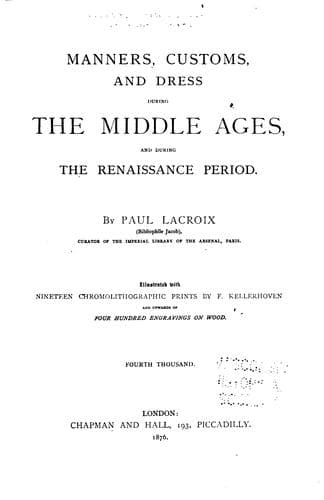
Manners, Customs, and Dress During the Middle Ages and During the Renaissance PeriodJacob, P. L.
History
Manners, Customs, and Dress During the Middle Ages and During the Renaissance Period
Jacob, P. L.
Clothing and dress; Manners and customs; Middle Ages; Renaissance
The tax collectors (_maltôtiers_, a name derived from the Italian _mala
tolta_, unjust tax), receivers, or farmers of taxes, paid dearly for
exercising their calling, which was always a dishonourable one, and was at
times exercised with a great amount of harshness and even of cruelty. The
treasury required a certain number of _deniers, oboles_, or _pittes_ (a
small coin varying in value in each province) to be paid by these men for
each bank operation they effected, and for every pound in value of
merchandise they sold, for they and the Jews were permitted to carry on
trades of all kinds without being subject to any kind of rates, taxes,
work, military service, or municipal dues.
Philippe le Bel, owing to his interminable wars against the King of
Castille, and against England, Germany, and Flanders, was frequently so
embarrassed as to be obliged to resort to extraordinary subsidies in order
to carry them on. In 1295, he called upon his subjects for a forced loan,
and soon after he shamelessly required them to pay the one-hundredth part
of their incomes, and after but a short interval he demanded another
fiftieth part. The king assumed the exclusive right to debase the value of
the coinage, which caused him to be commonly called the _base coiner_, and
no sovereign ever coined a greater quantity of base money. He changed the
standard or name of current coin with a view to counterbalance the
mischief arising from the illicit coinage of the nobles, and especially to
baffle the base traffic of the Jews and Lombards, who occasionally would
obtain possession of a great part of the coin, and mutilate each piece
before restoring it to circulation; in this way they upset the whole
monetary economy of the realm, and secured immense profits to themselves
(Figs. 273 to 278).
Public-domain text, read in full here on John Shaqi.
Reviews
Reviews
No reviews yet
Be the first to share your thoughts on this work.
Elsewhere in the archive
Join the Discussion
Join the discussion
Sign in to leave a comment or review.
Sign InorCreate an account