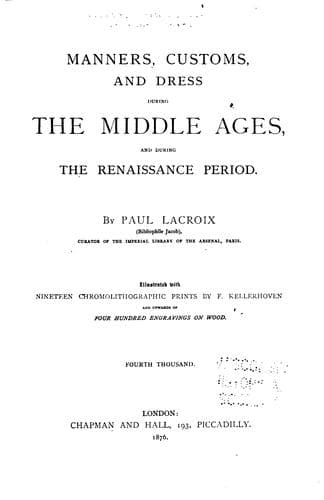
Manners, Customs, and Dress During the Middle Ages and During the Renaissance PeriodJacob, P. L.
History
Manners, Customs, and Dress During the Middle Ages and During the Renaissance Period
Jacob, P. L.
Clothing and dress; Manners and customs; Middle Ages; Renaissance
On the accession of Louis X., in 1315, war against the Flemish was
imminent, although the royal treasury was absolutely empty. The King
unfortunately, in spite of his father's advice, attempted systematically
to tamper with the coinage, and he also commenced the exaction of fresh
taxes, to the great exasperation of his subjects. He was obliged, through
fear of a general rebellion, to do away with the tithe established for the
support of the army, and to sacrifice the superintendent of finances,
Enguerrand de Marigny, to the public indignation which was felt against
him. This man, without being allowed to defend himself, was tried by an
extraordinary commission of parliament for embezzling the public money,
was condemned to death, and was hung on the gibbet of Montfauçon. Not
daring to risk a convocation of the States-General of the kingdom, Louis
X. ordered the seneschals to convoke the provincial assemblies, and thus
obtained a few subsidies, which he promised to refund out of the revenues
of his domains. The clergy even allowed themselves to be taxed, and closed
their eyes to the misappropriation of the funds, which were supposed to be
held in reserve for a new crusade. Taxes giving commercial franchise and
of exchange were levied, which were paid by the Jews, Lombards, Tuscans,
and other Italians; judiciary offices were sold by auction; the trading
class purchased letters of nobility, as they had already done under
Philippe le Bel; and, more than this, the enfranchisement of serfs, which
had commenced in 1298, was continued on the payment of a tax, which varied
according to the means of each individual. In consequence of this system,
personal servitude was almost entirely abolished under Philippe de Long,
brother of Louis X.
Each province, under the reign of this rapacious and necessitous monarch,
demanded some concession from the crown, and almost always obtained it at
a money value. Normandy and Burgundy, which were dreaded more than any
other province on account of their turbulence, received remarkable
concessions. The base coin was withdrawn from circulation, and Louis X.
attempted to forbid the right of coinage to those who broke the wise laws
of St. Louis. The idea of bills of exchange arose at this period.
Public-domain text, read in full here on John Shaqi.
Reviews
Reviews
No reviews yet
Be the first to share your thoughts on this work.
Elsewhere in the archive
Join the Discussion
Join the discussion
Sign in to leave a comment or review.
Sign InorCreate an account