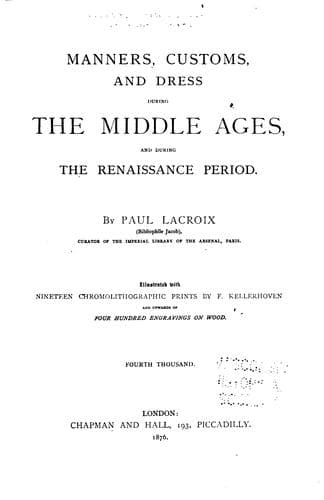
Manners, Customs, and Dress During the Middle Ages and During the Renaissance PeriodJacob, P. L.
History
Manners, Customs, and Dress During the Middle Ages and During the Renaissance Period
Jacob, P. L.
Clothing and dress; Manners and customs; Middle Ages; Renaissance
To meet emergencies, which were now becoming chronic,
extraordinary taxes were established, the non-payment of which involved
the immediate imprisonment of the defaulter; and the debasement of the
coinage, and the alienation of certain parts of the kingdom, were
authorised in the name of the King, who had been insane for more than
fifteen years. The incessant revolts of the bourgeois, the reappearance of
the English on the soil of France, the ambitious rivalry of Queen Isabel
of Bavaria leagued with the Duke of Burgundy against the Dauphin, who had
been made regent, at last, in 1420, brought about the humiliating treaty
of Troyes, by which Henry V., king of England, was to become king of
France on the death of Charles VI.
This treaty of Troyes became the cause of, and the pretext for, a vast
amount of extortion being practised upon the unfortunate inhabitants of
the conquered country. Henry V., who had already made several exactions
from Normandy before he had obtained by force the throne of France, did
not spare the other provinces, and, whilst proclaiming his good intentions
towards his future subjects, he added a new general impost, in the shape
of a forced loan, to the taxes which already weighed so heavily on the
people. He also issued a new coinage, maintained many of the taxes,
especially those on salt and on liquors, even after he had announced his
intention of abolishing them.
At the same time the Dauphin Charles, surnamed _Roi de Bourges_, because
he had retired with his court and retinue into the centre of the kingdom
(1422), was sadly in want of money. He alienated the State revenues, he
levied excise duties and subsidies in the provinces which remained
faithful to his cause, and he borrowed largely from those members of the
Church and the nobility who manifested a generous pity for the sad destiny
of the King and the monarchy. Many persons, however, instead of
sacrificing themselves for their king and country, made conditions with
him, taking advantage of his position. The heir to the throne was obliged
in many points to give way, either to a noble whose services he bargained
for, or to a town or an abbey whose aid he sought. At times he bought over
influential bodies, such as universities and other corporation, by
granting exemptions from, or privileges in, matters of taxation, &c. So
much was this the case that it may be said that Charles VII. treated by
private contract for the recovery of the inheritances of his fathers. The
towns of Paris and Rouen, as well as the provinces of Brittany, Languedoc,
Normandy, and Guyenne, only returned to their allegiance to the King on
conditions more or less advantageous to themselves. Burgundy, Picardy, and
Flanders--which were removed from the kingdom of Charles VII. at the
treaty of peace of Arras in 1435--cordially adopted the financial system
inaugurated by the Duke of Burgundy, Philip the Good.
Public-domain text, read in full here on John Shaqi.
Reviews
Reviews
No reviews yet
Be the first to share your thoughts on this work.
Elsewhere in the archive
Join the Discussion
Join the discussion
Sign in to leave a comment or review.
Sign InorCreate an account