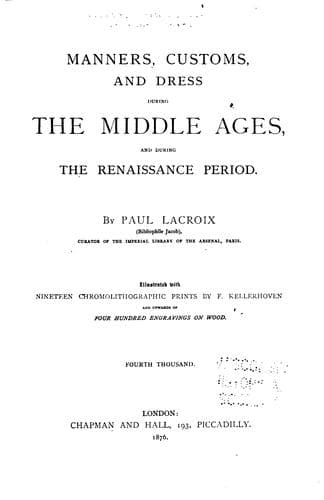
Manners, Customs, and Dress During the Middle Ages and During the Renaissance PeriodJacob, P. L.
History
Manners, Customs, and Dress During the Middle Ages and During the Renaissance Period
Jacob, P. L.
Clothing and dress; Manners and customs; Middle Ages; Renaissance
Philip the Good, Duke of Burgundy, taxed his subjects but little:
"Therefore," says Philippe de Commines, "they became very wealthy, and
lived in much comfort." But Louis XI did not imitate him. His first care
was to reinstate that great merchant, that clever financier, Jacques
Coeur, to whom, as much as to Joan of Arc, the kingdom owed its freedom,
and whom Charles VII., for the most contemptible reasons, had had the
weakness to allow to be judicially condemned Louis XI. would have been
very glad to entrust the care of his finances to another Jacques Coeur;
for being sadly in want of money, he ran through his father's earnings,
and, to refill his coffers, he increased taxation, imposed a duty on the
importation of wines, and levied a tax on those holding offices, &c. A
revolution broke out in consequence, which was only quenched in the blood
of the insurgents. In this manner he continued, by force of arms, to
increase and strengthen his own regal power at the expense of feudalism.
He soon found himself opposed by the _Ligue du Bien Public_, formed by the
great vassals ostensibly to get rid of the pecuniary burden which
oppressed the people, but really with the secret intention of restoring
feudalism and lessening the King's power. He was not powerful enough
openly to resist this, and appeared to give way by allowing the leagued
nobles immense privileges, and himself consenting to the control of a sort
of council of "thirty-six notables appointed to superintend matters of
finance." Far from acknowledging himself vanquished, however, he
immediately set to work to cause division among his enemies, so as to be
able to overcome them. He accordingly showed favour towards the bourgeois,
whom he had already flattered, by granting new privileges, and abolishing
or reducing certain vexatious taxes of which they complained. The
thirty-six notables appointed to control his financial management reformed
nothing. They were timid and docile under the cunning eye of the King, and
practically assisted him in his designs; for in a very few years the taxes
were increased from 1,800,000 écus--about 45,000,000 francs of present
money--to 3,600,000 écus--about 95,000,000 francs. Towards the end of the
reign they exceeded 4,700,000 écus--130,000,000 francs of present money.
Louis XI. wasted nothing on luxury and pleasure; he lived parsimoniously,
but he maintained 110,000 men under arms, and was ready to make the
greatest sacrifices whenever there was a necessity for augmenting the
territory of the kingdom, or for establishing national unity. At his
death, on the 25th of August, 1483, he left a kingdom considerably
increased in area, but financialty almost ruined.
Public-domain text, read in full here on John Shaqi.
Reviews
Reviews
No reviews yet
Be the first to share your thoughts on this work.
Elsewhere in the archive
Join the Discussion
Join the discussion
Sign in to leave a comment or review.
Sign InorCreate an account