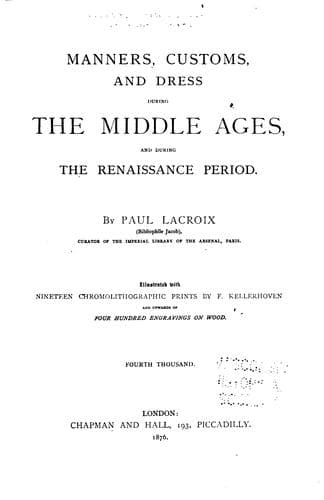
Manners, Customs, and Dress During the Middle Ages and During the Renaissance PeriodJacob, P. L.
History
Manners, Customs, and Dress During the Middle Ages and During the Renaissance Period
Jacob, P. L.
Clothing and dress; Manners and customs; Middle Ages; Renaissance
Domestic authority was represented by the _mund_, or head of the family,
also called _rex_ (the king), who exercised a special power over the
persons and goods of his dependents, a guardianship, in fact, with certain
rights and prerogatives, and a sort of civil and political responsibility
attached to it. Thus the head of the family, who was responsible for his
wife and for those of his children who lived with him, was also
responsible for his slaves and domestic animals. To such a pitch did these
primitive people carry their desire that justice should be done in all
cases of infringement of the law, that the head was held legally
responsible for any injury which might be done by the bow or the sword of
any of his dependents, without it being necessary that he should himself
have handled either of these weapons.
Long before the commencement of the Merovingian era, the family, whose
sphere of action had at first been an isolated and individual one, became
incorporated into one great national association, which held official
meetings at stated periods on the _Malberg_ (Parliament hill). These
assemblies alone possessed supreme power in its full signification. The
titles given to certain chiefs of _rex_ (king), _dux_ (duke), _graff_
(count), _brenn_ (general of the army), only defined the subdivisions of
that power, and were applied, the last exclusively, to those engaged in
war, and the others to those possessing judicial and administrative
functions. The duty of dispensing justice was specially assigned to the
counts, who had to ascertain the cause of quarrels between parties and to
inflict penalties. There was a count in each district and in each
important town; there were, besides, several counts attached to the
sovereign, under the title of counts of the palace (_comites palatii_), an
honourable position, which was much sought after and much coveted on
account of its pecuniary and other contingent advantages. The counts of
the palace deliberated with the sovereign on all matters and all questions
of State, and at the same time they were his companions in hunting,
feasting, and religious exercises; they acted as arbitrators in questions
of inheritance of the crown; during the minority of princes they exercised
the same authority as that which the constitution gave to sovereigns who
were of full age; they confirmed the nominations of the principal
functionaries and even those of the bishops; they gave their advice on the
occasion of a proposed alliance between one nation and another, on matters
connected with treaties of peace or of commerce, on military expeditions,
or on exchanges of territory, as well as in reference to the marriage of a
prince, and they incurred no responsibility beyond that naturally attached
to persons in so distinguished a position among a semi-barbarous
community. At first the legates (_legati_), and afterwards the King's
ambassadors (_missi dominici_), the bishops and the dukes or commanders of
Public-domain text, read in full here on John Shaqi.
Reviews
Reviews
No reviews yet
Be the first to share your thoughts on this work.
Elsewhere in the archive
Join the Discussion
Join the discussion
Sign in to leave a comment or review.
Sign InorCreate an account