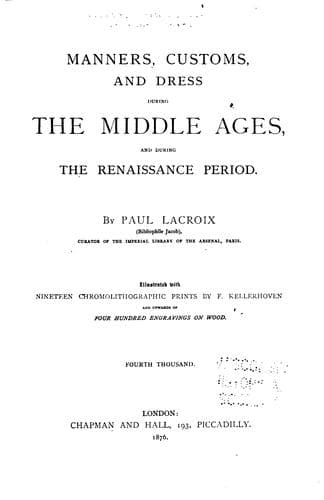
Manners, Customs, and Dress During the Middle Ages and During the Renaissance PeriodJacob, P. L.
History
Manners, Customs, and Dress During the Middle Ages and During the Renaissance Period
Jacob, P. L.
Clothing and dress; Manners and customs; Middle Ages; Renaissance
responsible, the benefices which had been withdrawn from the _leudes_ were
restored, the King was forbidden from granting written orders (_præcepta_)
for carrying off rich widows, young virgins, and nuns; and the penalty of
death was ordered to be enforced against those who disobeyed the canons of
the council. Thence sprung two new species of legislation, one
ecclesiastical, the other civil, between which royalty, more and more
curtailed of its authority, was compelled for many centuries to struggle.
Amongst the Germanic nations the right of justice was inherent to landed
property from the earliest times, and this right had reference to things
as well as to persons. It was the patronage (_patrocinium_) of the
proprietor, and this patronage eventually gave origin to feudal
jurisdictions and to lordly and customary rights in each domain. We may
infer from this that under the two first dynasties laws were made by
individuals, and that each lord, so to speak, made his own.
The right of jurisdiction seems to have been so inherent to the right of
property, that a landed proprietor could always put an end to feuds and
personal quarrels, could temporarily bring any lawsuit to a close, and, by
issuing his _ban_, stop the course of the law in his own immediate
neighbourhood--at least, within a given circumference of his residence.
This was often done during any family festival, or any civil or religious
public ceremony. On these occasions, whoever infringed the _ban_ of the
master, was liable to be brought before his _court_, and to have to pay a
fine. The lord who was too poor to create a court of sufficient power and
importance obtained assistance from his lord paramount or relinquished the
right of justice to him; whence originated the saying, "The fief is one
thing, and justice another."
The law of the Visigoths speaks of nobles holding local courts, similar to
those of the official judge, count, or bishop. King Dagobert required the
public and the private judges to act together. In the law of Lombardy
landlords are mentioned who, in virtue of the double title of nobles and
judges, assumed the right of protecting fugitive slaves taking shelter in
their domains. By an article of the Salie law, the noble is made to answer
for his vassal before the court of the count. We must hence conclude that
the landlord's judgment was exercised indiscriminately on the serfs, the
colons, and the vassals, and a statute of 855 places under his authority
even the freemen who resided with other persons.
From these various sources we discover a curious fact, which has hitherto
remained unnoticed by historians--namely, that there existed an
intermediate legislation between the official court of the count and his
subordinates and the private courts, which was a kind of court of
arbitration exercised by the neighbours (_vicini_) without the assistance
of the judges of the county, and this was invested with a sort of
authority which rendered its decisions binding.
Public-domain text, read in full here on John Shaqi.
Reviews
Reviews
No reviews yet
Be the first to share your thoughts on this work.
Elsewhere in the archive
Join the Discussion
Join the discussion
Sign in to leave a comment or review.
Sign InorCreate an account