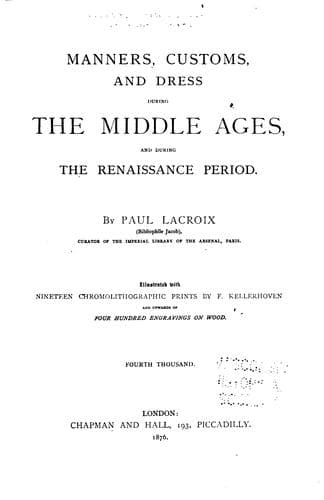
Manners, Customs, and Dress During the Middle Ages and During the Renaissance PeriodJacob, P. L.
History
Manners, Customs, and Dress During the Middle Ages and During the Renaissance Period
Jacob, P. L.
Clothing and dress; Manners and customs; Middle Ages; Renaissance
We must not suppose that justice in those days was dispensed without
formalities, and that there were no regular intervals between the various
steps to be gone through before final judgment was given, and in
consequence of which some guarantee was afforded that the decisions
arrived at were carefully considered. No one was tried without having been
previously summoned to appear before the tribunal. Under the
Carlovingians, as in previous times, the periods when judicial courts were
held were regulated by the moon. Preference was given to the day on which
it entered the first quarter, or during the full moon; the summonses were
returnable by moons or quarter moons--that is, every seventh day. The
summons was issued four times, after which, if the accused did not appear,
he lost the right of counterplea, or was nonsuited. The Salic law allowed
but two summonses before a count, which had to be issued at an interval of
forty nights the one from the other. The third, which summoned the accused
before the King, was issued fourteen nights later, and if he had not put
in an appearance before sunset on the fourteenth day, he was placed _hors
de sa parole_, his goods were confiscated, and he forfeited the privilege
of any kind of refuge.
Among the Visigoths justice was equally absolute from the count to the
tithe-gatherer. Each magistrate had his tribunal and his special
jurisdiction. These judges called to their assistance assessors or
colleagues, either _rachimbourgs_, who were selected from freemen; or
provosts, or _échevins_ (_scabini_), whose appointment was of an official
and permanent character. The scabins created by Charlemagne were the first
elected magistrates. They numbered seven for each bench. They alone
prepared the cases and arranged as to the sentence. The count or his
delegate alone presided at the tribunal, and pronounced the judgment.
Every vassal enjoyed the right of appeal to the sovereign, who, with his
court, alone decided the quarrels between ecclesiastics and nobles, and
between private individuals who were specially under the royal protection.
Criminal business was specially referred to the sovereign, the _missi_, or
the Count Palatine. Final appeal lay with the Count Palatine in all cases
in which the public peace was endangered, such as in revolts or in armed
encounters.
Public-domain text, read in full here on John Shaqi.
Reviews
Reviews
No reviews yet
Be the first to share your thoughts on this work.
Elsewhere in the archive
Join the Discussion
Join the discussion
Sign in to leave a comment or review.
Sign InorCreate an account