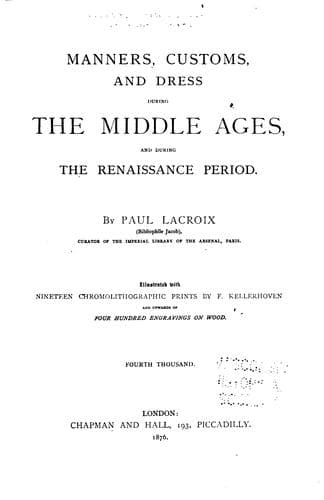
Manners, Customs, and Dress During the Middle Ages and During the Renaissance PeriodJacob, P. L.
History
Manners, Customs, and Dress During the Middle Ages and During the Renaissance Period
Jacob, P. L.
Clothing and dress; Manners and customs; Middle Ages; Renaissance
As that advanced reformer, Philippe le Bel, died before the institutions
he had established had taken root, for many years, even down to the time
of Louis XI., a continual conflict for supremacy was waged between the
Parliament of Paris and the various courts of the kingdom--between the
counts and the Parliament, and between the latter and the King, which,
without lessening the dignity of the crown, gradually tended to increase
the influence which the judges possessed. Immediately on the accession of
Louis le Hutin, in 1314, a reaction commenced--the higher clergy
re-entered Parliament; but Philippe le Long took care that the laity
should be in a majority, and did not allow that in his council of State
the titled councillors should be more numerous than the lawyers. The
latter succeeded in completely carrying the day on account of the services
they rendered, and the influence which their knowledge of the laws of the
country gave them. As for centuries the sword had ruled the gown, so,
since the emancipation of the bourgeois, the lawyers had become masters of
the administrative and judicial world; and, notwithstanding the fact that
they were still kept in a somewhat inferior position to the peers and
barons, their opinion alone predominated, and their decision frequently at
once settled the most important questions.
An edict issued at Val Notre-Dame on the 11th of March, 1344, increased
the number of members of Parliament, which from that time consisted of
three presidents, fifteen clerical councillors, fifteen lay councillors,
twenty-four clergymen and sixteen laymen of the Court of Inquiry, and five
clergymen and sixteen laymen of the Court of Petitions. The King filled up
the vacant seats on the recommendation of the Chancellor and of the
Parliament. The reporters were enjoined to write the decisions and
sentences which were given by the court "in large letters, and far apart,
so that they might be more easily read." The duties of police in the
courts, the keeping of the doors, and the internal arrangements generally
for those attending the courts and the Parliament, were entrusted to the
ushers, "who divided among themselves the gratuities which were given them
by virtue of their office." Before an advocate was admitted to plead he
was required to take oath and to be inscribed on the register.
Public-domain text, read in full here on John Shaqi.
Reviews
Reviews
No reviews yet
Be the first to share your thoughts on this work.
Elsewhere in the archive
Join the Discussion
Join the discussion
Sign in to leave a comment or review.
Sign InorCreate an account