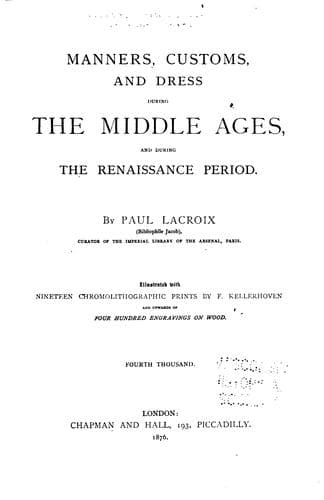
Manners, Customs, and Dress During the Middle Ages and During the Renaissance PeriodJacob, P. L.
History
Manners, Customs, and Dress During the Middle Ages and During the Renaissance Period
Jacob, P. L.
Clothing and dress; Manners and customs; Middle Ages; Renaissance
the salaries, Parliament sent him the bailiff's usher, and put him under
certain penalties until he had done so. The question of salaries was
frequently arising. On the 9th of February, 1369, "the court having been
requested to serve without any remuneration for one Parliament, on the
understanding that the King would make up for it another time, the nobles
of the court replied, after private deliberation, that they were ready to
do the King's pleasure, but could not do so properly without receiving
their salaries" (Register of the Parliament of Paris).
At the commencement of the fifteenth century, the scale of remuneration
was not increased. In 1411 it was raised for the whole Parliament to
twenty-five thousand livres, which, calculated according to the present
rate, amounted to nearly a million francs. In consequence of financial
difficulties and the general distress, the unpleasant question in
reference to claims for payment of salaries was renewed, with threats that
the course of justice would be interrupted if they were not paid or not
promised. On the 2nd of October, 1419, two councillors and one usher were
sent to the house of one of the chiefs of finance, with orders to demand
payment of the salaries of the court. In October, 1430, the government
owed the magistrates two years of arrears. After useless appeals to the
Regent, and to the Bishop of Thérouanne, the then Chancellor of France,
the Parliament sent two of its members to the King at Rouen, who obtained,
after much difficulty, "one month's pay, on the understanding that the
Parliament should hold its sittings in the month of April." In the month
of July, 1431, there was another deputation to the King, "in order to lay
before him the necessities of the court, and that it had for some time
been prorogued, and was still prorogued, on account of the non-payment of
salaries." After two months of repeated remonstrance, the deputies only
bringing back promises, the court assumed a menacing aspect; and on the
11th of January, 1437, it pointed out to the chancellor the evil which
would arise if Parliament ceased to hold its sittings; and this time the
chancellor announced that the salaries would be paid, though six months
passed without any resuit or any practical step being taken in the matter.
This state of affairs grew worse until the year 1443, when the King was
obliged to plead with the Parliament in the character of an insolvent
debtor, and, in order to obtain remission of part of his debt to the
members, to guarantee to them a part of the salt duties.
Public-domain text, read in full here on John Shaqi.
Reviews
Reviews
No reviews yet
Be the first to share your thoughts on this work.
Elsewhere in the archive
Join the Discussion
Join the discussion
Sign in to leave a comment or review.
Sign InorCreate an account