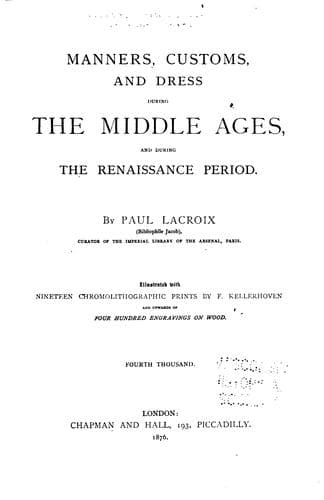
Manners, Customs, and Dress During the Middle Ages and During the Renaissance PeriodJacob, P. L.
History
Manners, Customs, and Dress During the Middle Ages and During the Renaissance Period
Jacob, P. L.
Clothing and dress; Manners and customs; Middle Ages; Renaissance
The first president received 4 livres, 22 solis parisis--about 140
francs--per day; a clerical councillor 25 sols parisis--about 40
francs--and a lay councillor 20 sols--about 32 francs. This was an
increase of a fifth on the preceding year. Charles VIII., in thus
improving the remuneration of the members of the first court of the
kingdom, reminded them of their duties, which had been too long neglected;
he told them "that of all the cardinal virtues justice was the most noble
and most important;" and he pointed out to them the line of conduct they
were to pursue. The councillors were to be present daily in their
respective chambers, from St. Martin's day to Easter, before seven o'clock
in the morning; and from Easter to the closing of Parliament, immediately
after six o'clock, without intermission, under penalty of punishment.
Strict silence was enforced upon them during the debates; and they were
forbidden to occupy themselves with anything which did not concern the
case under discussion. Amidst a mass of other points upon which directions
are given, we notice the following: the necessity of keeping secret the
matters in course of deliberation; the prohibition to councillors from
receiving, either directly or indirectly, anything in the shape of a
douceur from the parties in any suit; and the forbidding all attorneys
from receiving any bribe or claiming more than the actual expenses of a
journey and other just charges.
The great charter of the Parliament, promulgated in April, 1453, was thus
amended, confirmed, and completed, by this code of Charles VIII., with a
wisdom which cannot be too highly extolled.
The magistrature of the supreme courts had been less favoured during the
preceding reign. Louis XI., that cautious and crafty reformer, after
having forbidden ecclesiastical judges to examine cases referring to the
revenues of vacant benefices, remodelled the secular courts, but he
ruthlessly destroyed anything which offended him personally. For this
reason, as he himself said, he limited the power of the Parliaments of
Paris and Toulouse, by establishing, to their prejudice, several other
courts of justice, and by favouring the Châtelet, where he was sure always
to find those who would act with him against the aristocracy. The
Parliament would not give way willingly, nor without the most determined
opposition. It was obliged, however, at last to succumb, and to pass
certain edicts which were most repugnant to it. On the death of Louis XI.,
however, it took its revenge, and called those who had been his favourites
and principal agents to answer a criminal charge, for no other reason than
that they had exposed themselves to the resentment of the supreme court.
Public-domain text, read in full here on John Shaqi.
Reviews
Reviews
No reviews yet
Be the first to share your thoughts on this work.
Elsewhere in the archive
Join the Discussion
Join the discussion
Sign in to leave a comment or review.
Sign InorCreate an account