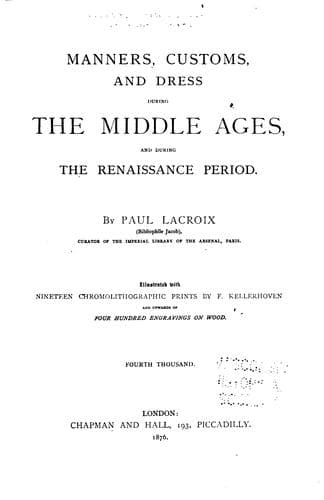
Manners, Customs, and Dress During the Middle Ages and During the Renaissance PeriodJacob, P. L.
History
Manners, Customs, and Dress During the Middle Ages and During the Renaissance Period
Jacob, P. L.
Clothing and dress; Manners and customs; Middle Ages; Renaissance
During the Middle Ages, human life was generally held in small respect;
various judicial institutions--if not altogether secret, at least more or
less enveloped in mystery--were remarkable for being founded on the
monstrous right of issuing the most severe sentences with closed doors,
and of executing these sentences with inflexible rigour on individuals who
had not been allowed the slightest chance of defending themselves.
While passing judgment in secret, they often openly dealt blows as
unexpected and terrible as they were fatal. Therefore, the most innocent
and the most daring trembled at the very name of the _Free Judges of the
Terre-Rouge,_ an institution which adopted Westphalia as the special, or
rather as the central, region of its authority; the _Council of Ten_
exercised their power in Venice and the states of the republic; and the
_Assassins_ of Syria, in the time of St. Louis, made more than one
invasion into Christian Europe. We must nevertheless acknowledge that,
terrible as these mysterious institutions were, the general credulity, the
gross ignorance of the masses, and the love of the marvellous, helped not
a little to render them even more outrageous and alarming than they really
were.
Marco Polo, the celebrated Venetian traveller of the thirteenth century,
says, "We will speak of the Old Man of the Mountain. This prince was named
Alaodin. He had a lovely garden full of all manner of trees and fruits, in
a beautiful valley, surrounded by high hills; and all round these
plantations were various palaces and pavilions, decorated with works of
art in gold, with paintings, and with furniture of silk. Therein were to
be seen rivulets of wine, as well as milk, honey, and gentle streams of
limpid water. He had placed therein damsels of transcendent beauty and
endowed with great charms, who were taught to sing and to play all manner
of instruments; they were dressed in silk and gold, and continually walked
in these gardens and palaces. The reasons for which the Old Man had these
palaces built were the following. Mahomet having said that those who
should obey his will should go to paradise, and there find all kinds of
luxuries, this prince wished it to be believed that he was the prophet and
companion of Mahomet, and that he had the power of sending whom he chose
to paradise. No one could succeed in entering the garden, because an
impregnable castle had been built at the entrance of the valley, and it
could only be approached by a covered and secret way. The Old Man had in
his court some young men from ten to twenty years of age, chosen from
those inhabitants of the hills who seemed to him capable of bearing arms,
and who were bold and courageous. From time to time he administered a
certain drink to ten or twelve of these young men, which sent them to
sleep, and when they were in deep stupor, he had them carried into the
garden. When they awoke, they saw all we have described: they were
Public-domain text, read in full here on John Shaqi.
Reviews
Reviews
No reviews yet
Be the first to share your thoughts on this work.
Elsewhere in the archive
Join the Discussion
Join the discussion
Sign in to leave a comment or review.
Sign InorCreate an account