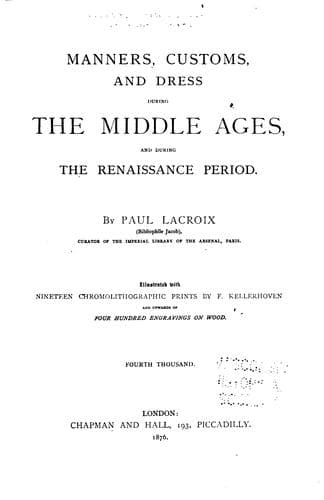
Manners, Customs, and Dress During the Middle Ages and During the Renaissance PeriodJacob, P. L.
History
Manners, Customs, and Dress During the Middle Ages and During the Renaissance Period
Jacob, P. L.
Clothing and dress; Manners and customs; Middle Ages; Renaissance
However it came about, it is certain that although during the tenth
century feudal power was almost supreme in Europe, as early as the twelfth
century the municipal system had gained great weight, and was constantly
progressing until the policy of the kingdom became developed on a more and
more extended basis, so that it was then necessary for it to give up its
primitive nature, and to participate in the great movement of
consolidisation and national unity. In this way the position of the large
towns in the state relatively lost their individual position, and became
somewhat analogous, as compared with the kingdom at large, to that
formerly held by bourgeois in the cities. Friendly ties arose between
provinces; and distinct and rival interests were effaced by the general
aspiration towards common objects. The towns were admitted to the states
general, and the citizens of various regions mixed as representatives of
the _Tiers Etat_. Three orders thus met, who were destined to struggle for
predominance in the future.
We must call attention to the fact that, as M. Henri Martin says, by an
apparent contradiction, the fall of the Communes declared itself in
inverse ratio to the progress of the _Tiers Etat_. By degrees, as the
government became more settled from the great fiefs being absorbed by the
Crown, and as parliament and other courts of appeal which emanated from
the middle class extended their high judiciary and military authority, so
the central power, organized under monarchical form, must necessarily have
been less disposed to tolerate the local independence of the Communes. The
State replaced the Commune for everything concerning justice, war, and
administration. No doubt some valuable privileges were lost; but that was
only an accidental circumstance, for a great social revolution was
produced, which cleared off at once all the relics of the old age; and
when the work of reconstruction terminated, homage was rendered to the
venerable name of "Commune," which became uniformly applied to all towns,
boroughs, or villages into which the new spirit of the same municipal
system was infused.
[Illustration: Fig. 40.--Various Arms of the Fifteenth Century.]
Private Life in the Castles, the Towns, and the Rural Districts.
The Merovingian Castles.--Pastimes of the Nobles; Hunting,
War.--Domestic Arrangements.--Private Life of Charlemagne.--Domestic
Habits under the Carlovingians.--Influence of Chivalry.--Simplicity of
the Court of Philip Angustus not imitated by his Successors.--Princely
Life of the Fifteenth Century.--The bringing up of Latour Landry, a
Noble of Anjou.--Varlets, Pages, Esquires, Maids of Honour.--Opulence of
the Bourgeoisie.--"Le Menagier de Paris."--Ancient Dwellings.--State of
Rustics at various Periods.--"Rustic Sayings," by Noël du Fail.
Augustin Thierry, taking Gregory of Tours, the Merovingian Herodotus, as
an authority, thus describes a royal domain under the first royal dynasty
of France:--
Public-domain text, read in full here on John Shaqi.
Reviews
Reviews
No reviews yet
Be the first to share your thoughts on this work.
Elsewhere in the archive
Join the Discussion
Join the discussion
Sign in to leave a comment or review.
Sign InorCreate an account