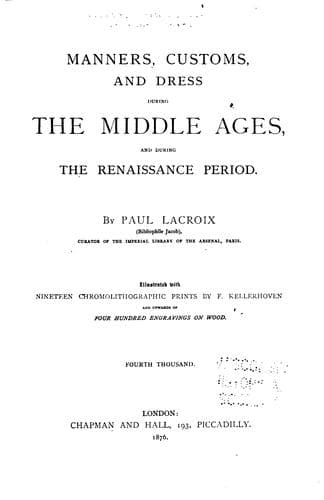
Manners, Customs, and Dress During the Middle Ages and During the Renaissance PeriodJacob, P. L.
History
Manners, Customs, and Dress During the Middle Ages and During the Renaissance Period
Jacob, P. L.
Clothing and dress; Manners and customs; Middle Ages; Renaissance
The vast empire which Charlemagne had formed became gradually split up, so
that from a dread of social destruction, in order to protect churches and
monasteries, as well as castles and homesteads, from the attacks of
internal as well as foreign enemies, towers and impregnable fortresses
began to rise in all parts of Europe, and particularly in France.
[Illustration: Fig. 46.--Towers of the Castle of Sémur, and of the Castle
of Nogent-le-Rotrou (Present Condition).--Specimens of Towers of the
Thirteenth Century.]
During the first period of feudalism, that is to say from the middle of
the ninth to the middle of the twelfth centuries, the inhabitants of
castles had little time to devote to the pleasures of private life. They
had not only to be continually under arms for the endless quarrels of the
King and the great chiefs; but they had also to oppose the Normans on one
side, and the Saracens on the other, who, being masters of the Spanish
peninsula, spread like the rising tide in the southern counties of
Languedoc and Provence. It is true that the Carlovingian warriors obtained
a handsome and rich reward for these long and sanguinary efforts, for at
last they seized upon the provinces and districts which had been
originally entrusted to their charge, and the origin of their feudal
possession was soon so far forgotten, that their descendants pretended
that they held the lands, which they had really usurped regardless of
their oath, from heaven and their swords. It is needless to say, that at
that time the domestic life in these castles must have been dull and
monotonous; although, according to M. Guizot, the loneliness which was the
resuit of this rough and laborious life, became by degrees the pioneer of
civilisation.
"When the owner of the fief left his castle, his wife remained there,
though in a totally different position from that which women generally
held. She remained as mistress, representing her husband, and was charged
with the defence and honour of the fief. This high and exalted position,
in the centre of domestic life, often gave to women an opportunity of
displaying dignity, courage, virtue, and intelligence, which would
otherwise have remained hidden, and, no doubt, contributed greatly to
their moral development, and to the general improvement of their
condition.
[Illustration: Fig. 47.--Woman under the Safeguard of Knighthood,
allegorical Scene.--Costume of the End of the Fifteenth Century, from a
Miniature in a Latin Psalm Book (Manuscript No. 175, National Library of
Paris).]
Public-domain text, read in full here on John Shaqi.
Reviews
Reviews
No reviews yet
Be the first to share your thoughts on this work.
Elsewhere in the archive
Join the Discussion
Join the discussion
Sign in to leave a comment or review.
Sign InorCreate an account