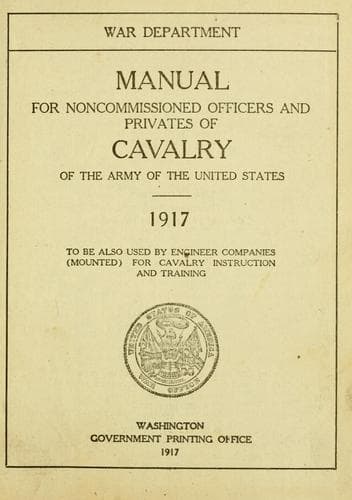
Manual for Noncommissioned Officers and Privates of Cavalry of the Army: of the United States 1917. To be also used by Engineer Companies (Mounted) for Cavalry Instruction and TrainingUnited States. War Department
History
Manual for Noncommissioned Officers and Privates of Cavalry of the Army: of the United States 1917. To be also used by Engineer Companies (Mounted) for Cavalry Instruction and Training
United States. War Department
United States. Army -- Handbooks, manuals, etc.
(_g_) Do not point the weapon in any direction where an accidental
discharge might do harm.
(_h_) After loading do not cock the revolver or unlock the pistol
until ready to fire.
(_i_) Keep the working parts properly lubricated.
=136.= =Position, dismounted=: Stand firmly on both feet, body
perfectly balanced and erect and turned at such an angle as is most
comfortable when the arm is extended toward the target; the feet far
enough apart to insure firmness and steadiness of position (about 8 to
10 inches); weight of body borne equally upon both feet; right arm
fully extended, left arm hanging naturally.
REMARKS.--The right arm may be slightly bent, although the difficulty
of holding the pistol uniformly and of keeping it as well as the
forearm in the same vertical plane makes this objectionable.
=137.= =The grip=: Grasp the stock as high as possible with the thumb
and last three fingers, the forefinger alongside the trigger guard,
the thumb extended along the stock. The barrel, hand, and forearm
should be as nearly in one line as possible when the weapon is pointed
toward the target. The grasp should not be so tight as to cause
tremors of the hand or arm to be communicated to the weapon, but
should be firm enough to avoid losing the grip when the recoil takes
place.
REMARKS.--The force of recoil of the pistol or revolver is exerted in
a line above the hand which grasps the stock. The lower the stock is
grasped the greater will be the movement or "jump" of the muzzle
caused by the recoil. This not only results in a severe strain upon
the wrist but in loss of accuracy.
If the hand be placed so that the grasp is on one side of the stock,
the recoil will cause a rotary movement of the weapon toward the
opposite side.
The releasing of the sear causes a slight movement of the muzzle,
generally to the left. The position of the thumb along the stock
overcomes much of this movement. The soldier should be encouraged to
practice this method of holding until it becomes natural.
To do uniform shooting the weapon must be held with exactly the same
grip for each shot. Not only must the hand grasp the stock at the same
point for each shot, but the tension of the grip must be uniform.
=138.= (_a_) =The trigger squeeze=: The trigger must be squeezed in
the same manner as in rifle firing. (See p. 193.) The pressure of the
forefinger on the trigger should be steadily increased and should be
straight back, not sideways. The pressure should continue to that
point beyond which the slightest movement will release the sear. Then,
when the aim is true, the additional pressure is applied and the
pistol fired.
Only by much practice can the soldier become familiar with the trigger
squeeze. This is essential to accurate shooting. It is the most
important detail to master in pistol or revolver shooting.
Public-domain text, read in full here on John Shaqi.
Reviews
Reviews
No reviews yet
Be the first to share your thoughts on this work.
Elsewhere in the archive
Join the Discussion
Join the discussion
Sign in to leave a comment or review.
Sign InorCreate an account