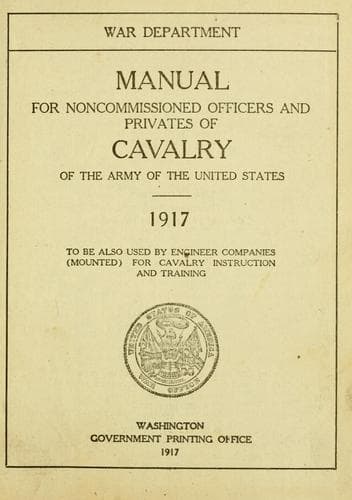
Manual for Noncommissioned Officers and Privates of Cavalry of the Army: of the United States 1917. To be also used by Engineer Companies (Mounted) for Cavalry Instruction and TrainingUnited States. War Department
History
Manual for Noncommissioned Officers and Privates of Cavalry of the Army: of the United States 1917. To be also used by Engineer Companies (Mounted) for Cavalry Instruction and Training
United States. War Department
United States. Army -- Handbooks, manuals, etc.
Whenever prisoners are brought to his post returning from work or
elsewhere, he will halt them and call the corporal of the guard,
notifying him of the number of prisoners returning. Thus: "=Corporal
of the guard, (so many) prisoners.="
He will not allow prisoners to pass into the guardhouse until the
corporal of the guard has responded to the call and ordered him to do
so.
=300.= Whenever practicable, special guards will be detailed for the
particular duty of guarding working parties composed of such prisoners
as can not be placed under overseers. (Par. 247.)
=301.= The prisoner guard and overseers will be commanded by the
police officer; if there be no police officer, then by the officer of
the day.
=302.= The provost sergeant is sergeant of the prisoner guard and
overseers, and as such receives orders from the commanding officer and
the commander of the prisoner guard only.
=303.= Details for prisoner guard are marched to the guardhouse and
mounted by being inspected by the commander of the main guard, who
determines whether all of the men are in proper condition to perform
their duties and whether their arms and equipments are in proper
condition, and rejects any men found unfit.
=304.= When prisoners have been turned over to the prisoner guard or
overseers, such guards or overseers are responsible for them under
their commander, and all responsibility and control of the main guard
ceases until they are returned to the main guard. (Par. 306.)
=305.= If a prisoner attempts to escape, the sentinel will call
"=Halt.=" If he fails to halt when the sentinel has once repeated his
call, and if there be no other possible means of preventing his
escape, the sentinel will fire upon him.
The following will more fully explain the important duties of a
sentinel in this connection:
(Circular.) WAR DEPARTMENT,
ADJUTANT GENERAL'S OFFICE,
_Washington, November 1, 1887_.
By direction of the Secretary of War, the following is published
for the information of the Army:
UNITED STATES CIRCUIT COURT, EASTERN DISTRICT OF MICHIGAN,
AUGUST 1, 1887.
THE UNITED STATES V. JAMES CLARK.
The circuit court has jurisdiction of a homicide committed by one
soldier upon another within a military reservation of the United
States.
If a homicide be committed by a military guard without malice and
in the performance of his supposed duty as a soldier, such
homicide is excusable, unless it was manifestly beyond the scope
of his authority or was such that a man of ordinary sense and
understanding would know that it was illegal.
It seems that the sergeant of the guard has a right to shoot a
military convict if there be no other possible means of
preventing his escape.
The common-law distinction between felonies and misdemeanors has
no application to military offenses.
Public-domain text, read in full here on John Shaqi.
Reviews
Reviews
No reviews yet
Be the first to share your thoughts on this work.
Elsewhere in the archive
Join the Discussion
Join the discussion
Sign in to leave a comment or review.
Sign InorCreate an account