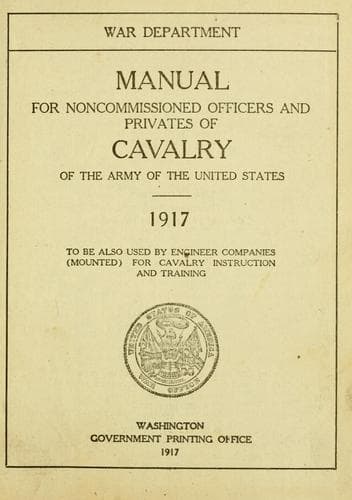
Manual for Noncommissioned Officers and Privates of Cavalry of the Army: of the United States 1917. To be also used by Engineer Companies (Mounted) for Cavalry Instruction and TrainingUnited States. War Department
History
Manual for Noncommissioned Officers and Privates of Cavalry of the Army: of the United States 1917. To be also used by Engineer Companies (Mounted) for Cavalry Instruction and Training
United States. War Department
United States. Army -- Handbooks, manuals, etc.
----------------------------------------------------------------------
The heading "From" is filled in with the _name_ of the detachment
sending the information: as "Officer's Patrol, 7th Cav." Messages sent
on the same day from the same source to the same person are numbered
consecutively. The address is written briefly, thus: "Commanding
officer, Outpost, 1st Brigade." In the signature the writer's surname
only and rank are given.
This blank is four and a half by six and three-quarters inches,
including the margin on the left for binding. The back is ruled in
squares, the side of each square representing 100 yards on a scale of
3 inches to one mile, for use in making simple sketches explanatory,
of the message. It is issued by the Signal Corps in blocks of forty
with duplicating sheets. The regulation envelope is three by five and
one-fourth inches and is printed as follows:
UNITED STATES ARMY FIELD MESSAGE.
_To_ ___________________________________________ _No_ ________________
(For signal operator only.)
----------------------------------------------------------------------
_When sent_ __________________________________________ _No_ __________
_Rate of speed_ ______________________________________________________
_Name of messenger_ __________________________________________________
_When and by whom rec'd_ _____________________________________________
=This Envelope will be Returned to Bearer.=
CHAPTER XII.
SIGNALS AND CODES.
(Extracts from Signal Book, United States Army, 1916.)
=General Instructions for Army Signaling.=
=1.= Each signal station will have its call, consisting of one or two
letters, as Washington, "W"; and each operator or signalist will also
have his personal signal of one or two letters, as Jones, "Jo." These
being once adopted will not be changed without due authority.
=2.= To lessen liability of error, numerals which occur in the body of
a message should be spelled out.
=3.= In receiving a message the man at the telescope should call out
each letter as received, and not wait for the completion of a word.
=4.= A record of the date and time of the receipt or transmission of
every message must be kept.
=5.= The duplicate manuscript of messages received at, or the original
sent from, a station should be carefully filed.
=6.= In receiving messages nothing should be taken for granted, and
nothing considered as seen until it has been positively and clearly in
view. Do not anticipate what will follow from signals already given.
Watch the communicating station until the last signals are made, and
be very certain that the signal for the end of the message has been
given.
=7.= Every address must contain at least two words and should be
sufficient to secure delivery.
=8.= All that the sender writes for transmission after the word "To"
is counted.
Public-domain text, read in full here on John Shaqi.
Reviews
Reviews
No reviews yet
Be the first to share your thoughts on this work.
Elsewhere in the archive
Join the Discussion
Join the discussion
Sign in to leave a comment or review.
Sign InorCreate an account