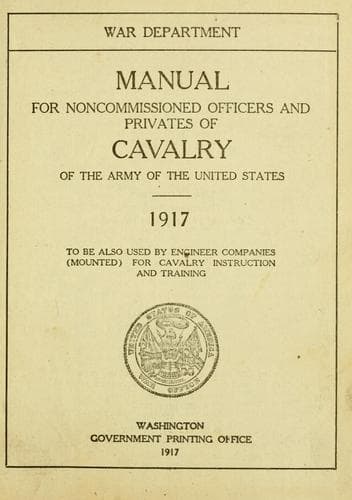
Manual for Noncommissioned Officers and Privates of Cavalry of the Army: of the United States 1917. To be also used by Engineer Companies (Mounted) for Cavalry Instruction and TrainingUnited States. War Department
History
Manual for Noncommissioned Officers and Privates of Cavalry of the Army: of the United States 1917. To be also used by Engineer Companies (Mounted) for Cavalry Instruction and Training
United States. War Department
United States. Army -- Handbooks, manuals, etc.
ART. 69. An officer charged with crime or with a serious offense under
these articles shall be placed in arrest by the commanding officer,
and in exceptional cases an officer so charged may be placed in
confinement by the same authority. A soldier charged with crime or
with a serious offense under these articles shall be placed in
confinement, and when charged with a minor offense he may be placed in
arrest. Any other person subject to military law charged with crime or
with a serious offense under these articles shall be placed in
confinement or in arrest, as circumstances may require; and when
charged with a minor offense such person may be placed in arrest. Any
person placed in arrest under the provisions of this article shall
thereby be restricted to his barracks, quarters, or tent, unless such
limits shall be enlarged by proper authority. Any officer who breaks
his arrest or who escapes from confinement before he is set at liberty
by proper authority shall be dismissed from the service or suffer such
other punishment as a court-martial may direct; and any other person
subject to military law who escapes from confinement or who breaks his
arrest before he is set at liberty by proper authority shall be
punished as a court-martial may direct.
INVESTIGATION OF AND ACTION UPON CHARGES.
ART 70. No person put in arrest shall be continued in confinement more
than eight days, or until such time as a court-martial can be
assembled. When any person is put in arrest for the purpose of trial,
except at remote military posts or stations, the officer by whose
order he is arrested shall see that a copy of the charges on which he
is to be tried is served upon him within eight days after his arrest,
and that he is brought to trial within 10 days thereafter, unless the
necessities of the service prevent such trial; and then he shall be
brought to trial within 30 days after the expiration of said 10 days.
If a copy of the charges be not served, or the arrested person be not
brought to trial, as herein required, the arrest shall cease. But
persons released from arrest, under the provisions of this article,
may be tried, whenever the exigencies of the service shall permit,
within 12 months after such release from arrest: _Provided_, That in
time of peace no person shall, against his objection, be brought to
trial before a general court-martial within a period of five days
subsequent to the service of charges upon him.
REFUSAL TO RECEIVE AND KEEP PRISONERS.
ART. 71. No provost marshal or commander of a guard shall refuse to
receive or keep any prisoner committed to his charge by an officer
belonging to the forces of the United States, provided the officer
committing shall, at the time, deliver an account in writing, signed
by himself, of the crime or offense charged against the prisoner. Any
officer or soldier so refusing shall be punished as a court-martial
may direct.
REPORT OF PRISONERS RECEIVED.
Public-domain text, read in full here on John Shaqi.
Reviews
Reviews
No reviews yet
Be the first to share your thoughts on this work.
Elsewhere in the archive
Join the Discussion
Join the discussion
Sign in to leave a comment or review.
Sign InorCreate an account