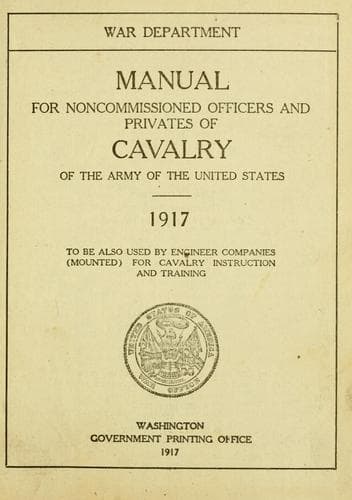
Manual for Noncommissioned Officers and Privates of Cavalry of the Army: of the United States 1917. To be also used by Engineer Companies (Mounted) for Cavalry Instruction and TrainingUnited States. War Department
History
Manual for Noncommissioned Officers and Privates of Cavalry of the Army: of the United States 1917. To be also used by Engineer Companies (Mounted) for Cavalry Instruction and Training
United States. War Department
United States. Army -- Handbooks, manuals, etc.
CONDUCT UNBECOMING AN OFFICER AND GENTLEMAN.
ART. 95. Any officer or cadet who is convicted of conduct unbecoming
an officer and a gentleman shall be dismissed from the service.
GENERAL ARTICLE.
ART. 96. Though not mentioned in these articles, all disorders and
neglects to the prejudice of good order and military discipline, all
conduct of a nature to bring discredit upon the military service, and
all crimes or offenses not capital of which persons subject to
military law may be guilty shall be taken cognizance of by a general
or special or summary court-martial, according to the nature and
degree of the offense, and punished at the discretion of such court.
DISCIPLINARY POWERS OF COMMANDING OFFICERS.
ART. 104. Under such regulations as the President may prescribe, and
which he may from time to time revoke, alter, or add to, the
commanding officer of any detachment, company, or higher command may,
for minor offenses not denied by the accused, impose disciplinary
punishments upon persons of his command without the intervention of a
court-martial, unless the accused demands trial by court-martial.
The disciplinary punishments authorized by this article may include
admonition, reprimand, withholding of privileges, extra fatigue, and
restriction to certain specified limits, but shall not include
forfeiture of pay or confinement under guard. A person punished under
authority of this article who deems his punishment unjust or
disproportionate to the offense may, through the proper channel,
appeal to the next superior authority, but, may in the meantime be
required to undergo the punishment adjudged. The commanding officer
who imposes the punishment, his successor in command, and superior
authority shall have power to mitigate or remit any unexecuted portion
of the punishment. The imposition and enforcement of disciplinary
punishment under authority of this article for any act or omission
shall not be a bar to trial by court-martial for a crime or offense
growing out of the same act or omission; but the fact that a
disciplinary punishment has been enforced may be shown by the accused
upon trial, and when so shown shall be considered in determining the
measure of punishment to be adjudged in the event of a finding of
guilty.
REDRESS OF INJURIES TO PERSON OR PROPERTY.
Public-domain text, read in full here on John Shaqi.
Reviews
Reviews
No reviews yet
Be the first to share your thoughts on this work.
Elsewhere in the archive
Join the Discussion
Join the discussion
Sign in to leave a comment or review.
Sign InorCreate an account