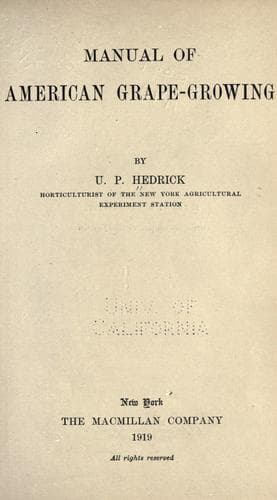
Grapes -- Varieties -- United States; Viticulture -- United States
"The pruning of Muscadine grapes during the first three years is
mainly for the purpose of establishing the permanent parts and
adjusting the other parts of the vine to the desired training system
for future usefulness. After that the pruning is primarily a matter of
renewing the bearing surface and keeping the vines healthy, vigorous,
and productive.
"During the first season the trunk of the vine should be established.
From this the main fruiting branches are started the second season.
These, under favorable circumstances, will bear a small crop of fruit
the third season. After that the purpose of pruning should be to renew
growth, to increase or decrease the bearing surface, and to maintain
the shape of the vine.
"Severe pruning usually removes most of the fruit-bearing wood and
throws the vine into vigorous wood growth. No pruning, on the other
hand, causes a growth which is too much distributed, weak, and
incapable of bearing good crops. Therefore, the grape grower should
study the vines sufficiently to enable him to judge each year the
proper severity of pruning for the best results. This will depend on
the variety, the age of the vines, the fertility of the soil, etc.
Muscadine grapes bear their fruit in small clusters. It is therefore
necessary to maintain a large fruiting surface in order to secure a
proper tonnage of fruit. This is accomplished by developing a series
of fruiting arms, spurring along these, and lengthening them as the
vines become stronger. Such fruiting arms can be maintained for a
number of years, but after a time it is desirable to renew them. This
is done by cutting out the arm and starting a new one from a cane that
has been previously grown for such purposes. It is preferable to renew
systematically only one or, at most, two arms on a vine each year.
This gradual renewal does not disturb the vigor of the vine, but keeps
it productive, healthy, and strong. The pruning can be quickly and
easily done if systematically practiced from the time the vines are
started."
REJUVENATING OLD VINES
When pruning and training are neglected, a vineyard soon becomes a
sorry company of halt and maimed vines. These neglected vines can
rarely be reshaped and restored to their pristine vigor. If the old
vines seem capable of throwing out a strong new growth, it is almost
always better to grow a new top by taking out canes from the roots and
so rejuvenate. The energy and activity of Nature are seldom seen to
better advantage than in these new tops, if the old tops are cut back
severely and the vineyard given good care. The new canes grow with the
gusto of the biblical bay tree, making it difficult oftentimes to keep
them within bounds.
Public-domain text, read in full here on John Shaqi.
Reviews
Reviews
No reviews yet
Be the first to share your thoughts on this work.
Elsewhere in the archive
Join the Discussion
Join the discussion
Sign in to leave a comment or review.
Sign InorCreate an account