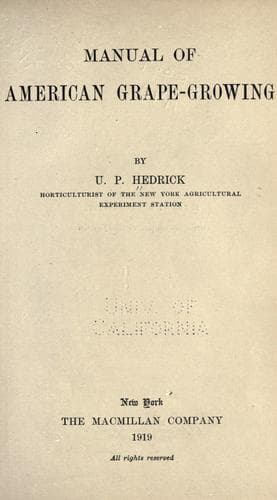
Grapes -- Varieties -- United States; Viticulture -- United States
"If a colored juice is desired, the crushed grapes are heated
immediately, usually in aluminum kettles having double bottoms, which
prevent the steam from coming in contact with the contents. These
kettles usually contain revolving cylinders, the arms of which keep
the crushed grapes thoroughly stirred while they are being heated to
about 140 deg. F. The simultaneous heating and stirring help to extract
the coloring matter from the skins, tear the cells of the berries,
increase the quantity of juice obtained per ton of fruit, and give to
the must many ingredients of red wine, with the substitution of grape
sugar for alcohol of the wine.
"The aluminum kettles are filled and emptied in rotation, thereby
making continuous manipulation possible. The presses should be
situated below the kettles, so that the hot juice can be drained
directly into them. The expressed juice is then reheated to about 165 deg.
F., skimmed, and run through the pasteurizer in the same manner in
which the white juice is handled. The juice passes from the
pasteurizer while still hot (about 160 deg. F.) into the container, which
should be sealed immediately. The lower the temperature (above the
freezing point) at which these containers are then stored, the less is
the danger of fermentation and the more rapidly the juice will clear
and deposit its sediment.
"The ordinary receptacles in which the juice is stored are 5-gallon
demijohns, 20-gallon carboys, or clean, new barrels or puncheons, well
washed and drained. All containers should be thoroughly sterilized
before they are filled, and the covers, corks, bungs, cloths, etc.,
used in sealing them should be scrupulously clean and carefully
sterilized. If barrels or puncheons are used as containers, they are
placed on skids and firmly wedged to prevent movement. As the juice
cools, air laden with fermentation germs is apt to be drawn into the
barrels by the decrease in the volume of the liquid. In order to
prevent this, tight air-filtering plugs of sterilized cotton are
sometimes used instead of the ordinary bungs of solid wood.
"The type of pasteurizer differs in almost every establishment. As the
industry is of comparatively recent development commercially, there
are few models on the market and each manufacturer has constructed the
model best suited to his particular ideas or requirements. There are
two general types, however, (1) open, double-bottomed kettles in which
the juice is heated to the required temperature and then drawn off,
and (2) continuous pasteurizers in which the juice is heated to the
required temperature as it passes through the water bath.
Public-domain text, read in full here on John Shaqi.
Reviews
Reviews
No reviews yet
Be the first to share your thoughts on this work.
Elsewhere in the archive
Join the Discussion
Join the discussion
Sign in to leave a comment or review.
Sign InorCreate an account