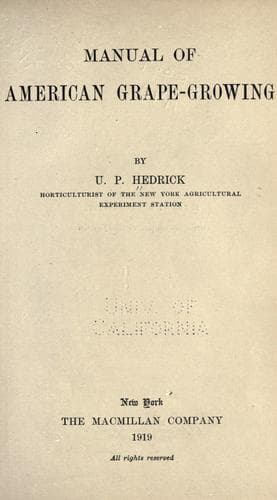
Grapes -- Varieties -- United States; Viticulture -- United States
Fruit mid-season, ships well and keeps into the winter. Clusters
large, blunt at the ends, usually not shouldered, with many
abortive fruits; pedicel long, slender, smooth; brush long, green.
Berries large, oval, dull green changing to a faint yellow with
thin bloom; skin thick, tough, unpigmented; flesh pale green,
tender, soft, vinous, sweet at skin but tart at center; fair to
good. Seeds of medium size and length.
GOETHE
(Vinifera, Labrusca)
Of all Rogers' hybrids, Goethe shows Vinifera characters most,
resembling in appearance the White Malaga of Europe, and not falling
far short of the best Old World grapes in quality. But the variety is
difficult to grow, especially where the seasons are not long enough
for full maturity. The vine is vigorous to a fault; it is fairly
immune to mildew, rot and other diseases; and, where it succeeds, the
vines bear so freely that thinning becomes a necessity. Added to high
quality, which makes it an excellent table-grape, Goethe keeps well.
Goethe was first mentioned in 1858 under the name of Rogers' No. 1.
Vine vigorous, hardy. Canes short, dark brown; nodes enlarged,
flattened; internodes short; tendrils continuous or intermittent,
long, bifid to trifid. Leaves irregularly round, thin; upper
surface light green, glossy; lower surface pale green, pubescent;
leaf usually not lobed, terminus broadly acute; petiolar sinus
narrow, closed and overlapping; basal sinus usually lacking;
lateral sinus shallow, often a notch; teeth shallow, narrow.
Flowers partly self-fertile, open in mid-season; stamens upright.
Fruit late, keeps well. Clusters short, broad, tapering,
frequently single-shouldered, usually two bunches to shoot;
pedicel long, thick with numerous conspicuous warts; brush long,
slender, yellowish-brown. Berries very large, oval, pale red
covered with thin bloom, persistent; skin thin, tender, adherent,
faintly astringent; flesh pale green, translucent, tender with
Vinifera flavor; very good. Seeds adherent, one to three, large,
long, notched, blunt, brown.
GOLD COIN
(AEstivalis, Labrusca)
In the South, where alone it thrives, Gold Coin is a handsome market
variety of very good quality. The vines are productive and are
unusually free from attacks of fungal diseases. The variety
originated with T. V. Munson, Denison, Texas, from seed of Cynthiana
or Norton pollinated by Martha and was introduced by the originator in
1894.
Vine vigorous, hardy, productive. Canes slender, numerous;
tendrils continuous, sometimes intermittent, trifid or bifid.
Leaves medium in size; upper surface light green, slightly rugose;
lower surface pale green, tinged with bronze, heavily pubescent.
Flowers self-fertile; stamens upright.
Public-domain text, read in full here on John Shaqi.
Reviews
Reviews
No reviews yet
Be the first to share your thoughts on this work.
Elsewhere in the archive
Join the Discussion
Join the discussion
Sign in to leave a comment or review.
Sign InorCreate an account