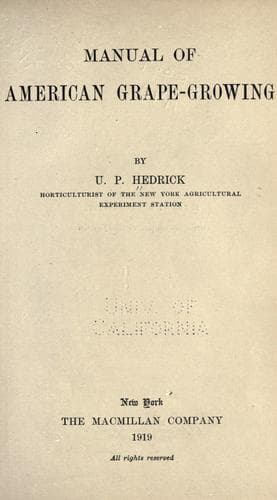
Grapes -- Varieties -- United States; Viticulture -- United States
By common consent, Lindley (Plate XXII) is the best of the red grapes
originated by Rogers in his crosses between Labrusca and Vinifera. The
bunches are of only medium size and are loose, but the berries are
well-formed, of uniform size and an attractive dark red color. The
flesh is firm, fine-grained, juicy, tender with a peculiarly rich
aromatic flavor. The skin is thick and tough but is not objectionable
in fruit fully ripe. The fruit keeps and ships well, and the berries
neither crack nor shatter. The vine is vigorous, hardy for a Vinifera
hybrid, healthy but, as with most of its kind, susceptible to mildew.
The chief defects of Lindley are self-sterility, precariousness in
bearing and lack of adaptation to many soils. Lindley is a general
favorite in the garden. In 1869 Rogers gave this grape its name in
honor of John Lindley, the English botanist.
Vine vigorous, usually hardy, susceptible to mildew. Canes very
long, dark reddish-brown with thin bloom; nodes enlarged, usually
flattened; internodes long, thick; tendrils continuous, long,
bifid or trifid. Leaves large, thick; upper surface light green,
dull, slightly rugose; lower surface grayish-white, pubescent;
obscurely three-lobed with terminus acute; petiolar sinus deep,
narrow, often closed and overlapping; teeth shallow. Flowers
self-sterile, open in mid-season; stamens reflexed.
Fruit mid-season, keeps and ships well. Clusters long, broad,
cylindrical, frequently single-shouldered, the shoulder being
connected to the bunch by a long stem, loose; pedicel short,
slender, smooth; brush short, pale green. Berries large,
round-oval, dark-red with faint bloom; skin tough, adherent,
unpigmented, strongly astringent; flesh pale green, translucent,
juicy, fine-grained, tender, vinous; good to best. Seeds adherent,
two to five, notched, brown.
LUCILE
(Labrusca)
In vigor, health, hardiness and productiveness, Lucile (Plate XXII) is
not surpassed by any native grape. Unfortunately, the fruit characters
are not so desirable. The size, form and color of bunches and berries
are good, making a very attractive fruit, but the grapes have an
obnoxious, foxy taste and odor and are pulpy and seedy. Lucile is
earlier than Concord, the crop ripening with that of Worden or
preceding it a few days. For an early variety, the fruit keeps well
and in spite of thin skin ships well. The vine thrives in all grape
soils. Lucile may be recommended where a hardy grape is desired and
for localities in which the season is short. J. A. Putnam, Fredonia,
New York, grew Lucile. The vine fruited first in 1890. It is a
seedling of Wyoming, which it resembles in fruit and vine and
surpasses in both.
Public-domain text, read in full here on John Shaqi.
Reviews
Reviews
No reviews yet
Be the first to share your thoughts on this work.
Elsewhere in the archive
Join the Discussion
Join the discussion
Sign in to leave a comment or review.
Sign InorCreate an account