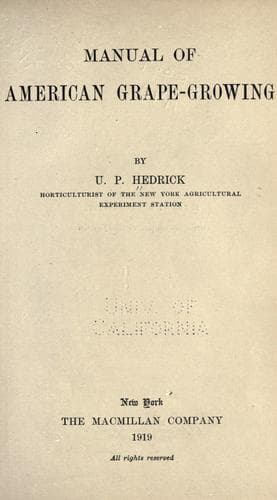
Grapes -- Varieties -- United States; Viticulture -- United States
Leaving the shaping of the plant out of consideration and having in
mind pruning proper, all efforts in pruning are directed toward two
objects: (1) The production of leafy shoots to increase the vigor of
the plant. (2) The promotion of the formation of fruit-buds. The
first, in common parlance, is pruning for wood; the second, pruning
for fruit.
_Pruning for wood._
Some grapes, in common with varieties of all fruits, produce excessive
crops of fruit so that the plants exhaust themselves, to their
permanent injury and to the detriment of the crop. Something must be
done to restore and increase vegetative vigor. The most natural
procedure is to lessen the struggle for existence among the parts of
the plant. The richer and the more abundant the supply of the food
solution, the greater the vegetative activity, the larger the leaves
and the larger and stouter the internodes. Obviously, the supply of
food solution for each bud may be increased by decreasing the number
of buds. The weaker the plants, therefore, the more the vine should be
cut. The severe pruning in the first two years of the vine's existence
is an example of pruning for wood. The vine is pruned for wood in the
resting period between the fall of leaf and the swelling of buds the
following spring.
_Pruning for fruit._
Growers of all fruits soon learn that excessive vegetative vigor is
not usually accompanied by fruitfulness. Too great vigor is indicated
by long, leafy, unbranching shoots. Some fruit-growers go so far as to
say that fruitfulness is inversely proportionate to vegetative vigor.
There are several methods of diminishing the vigor of the vine; as,
withholding water and fertilizers, stopping tillage, the method of
training and by pruning. Pruning is used to decrease the vigor of the
vine, in theory at least, for the practice is not always so
successful, by pruning the roots or by summer-pruning the shoots.
Root-pruning the grape at intervals of several years is a regular
practice with some varieties in warm countries, Europe more
especially, but is seldom or never practiced in America except when
planting and when roots arise from the cion above the union of stock
and cion.
Summer-pruning to induce fruitfulness consists in removing new shoots
with newly developed leaves. These young shoots have been developed
from reserve material stored up the preceding season, and until they
are so far developed that they can perform the functions of leaves
they are to be counted as parasites. When, therefore, these shoots are
pruned or pinched away, the plant is robbed of the material used by
the lusty shoot which up to this time has given nothing in return. The
vigor of the plant is thus checked and fruitfulness increased.
Summer-pruning may become harmful if delayed too long. The time to
prune is past with the grape when the leaves have passed from the
light green color of new growth to the dark green of mature leaves.
Public-domain text, read in full here on John Shaqi.
Reviews
Reviews
No reviews yet
Be the first to share your thoughts on this work.
Elsewhere in the archive
Join the Discussion
Join the discussion
Sign in to leave a comment or review.
Sign InorCreate an account