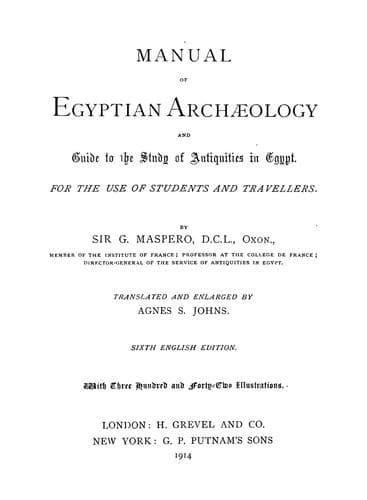
Manual of Egyptian Archaeology and Guide to the Study of Antiquities in EgyptMaspero, G. (Gaston)
History
Manual of Egyptian Archaeology and Guide to the Study of Antiquities in Egypt
Maspero, G. (Gaston)
Art -- Egypt; Egypt -- Antiquities
The sculptors of ancient Egypt were not so well equipped as those of our
own day. A kneeling scribe in limestone at the Gizeh Museum has been carved
with the chisel, the grooves left by the tool being visible on his skin. A
statue in grey serpentine, in the same collection, bears traces of the use
of two different tools, the body being spotted all over with point-marks,
and the unfinished head being blocked out splinter by splinter with a small
hammer. Similar observations, and the study of the monuments, show that the
drill (fig. 181), the toothed-chisel, and the gouge were also employed.
There have been endless discussions as to whether these tools were of iron
or of bronze. Iron, it is argued, was deemed impure. No one could make use
of it, even for the basest needs of daily life, without incurring a taint
prejudicial to the soul both in this world and the next. But the impurity
of any given object never sufficed to prevent the employment of it when
required. Pigs also were impure; yet the Egyptians bred them. They bred
them, indeed, so abundantly in certain districts, that our worthy Herodotus
tells us how the swine were turned into the fields after seed-sowing, in
order that they might tread in the grain. So also iron, like many other
things in Egypt, was pure or impure according to circumstances. If some
traditions held it up to odium as an evil thing, and stigmatised it as the
"bones of Typhon," other traditions equally venerable affirmed that it was
the very substance of the canopy of heaven. So authoritative was this view,
that iron was currently known as "_Ba-en-pet_," or the celestial metal.[35]
The only fragment of metal found in the great pyramid is a piece of plate-
iron;[36] and if ancient iron objects are nowadays of exceptional rarity as
compared with ancient bronze objects, it is because iron differs from
bronze, inasmuch as it is not protected from destruction by its oxide. Rust
speedily devours it, and it needs a rare combination of favourable
circumstances to preserve it intact. If, however, it is quite certain that
the Egyptians were acquainted with, and made use of, iron, it is no less
certain that they were wholly unacquainted with steel. This being the case,
one asks how they can possibly have dealt at will upon the hardest rocks,
even upon such as we ourselves hesitate to attack, namely, diorite, basalt,
and the granite of Syene. The manufacturers of antiquities who sculpture
granite for the benefit of tourists, have found a simple solution of this
problem. They work with some twenty common iron chisels at hand, which
after a very few turns are good for nothing. When one is blunted, they take
up another, and so on till the stock is exhausted. Then they go to the
forge, and put their tools into working order again. The process is neither
so long nor so difficult as might be supposed. In the Gizeh Museum is a
life-size head, produced from a block of black and red granite in less than
Public-domain text, read in full here on John Shaqi.
Reviews
Reviews
No reviews yet
Be the first to share your thoughts on this work.
Elsewhere in the archive
Join the Discussion
Join the discussion
Sign in to leave a comment or review.
Sign InorCreate an account