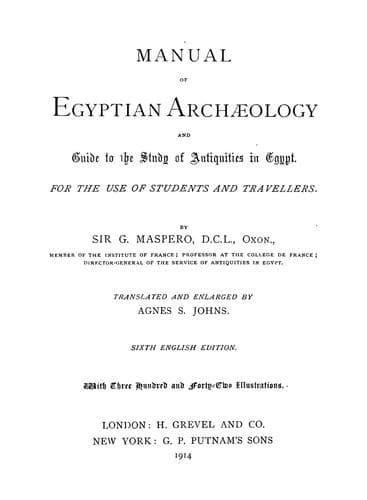
Manual of Egyptian Archaeology and Guide to the Study of Antiquities in EgyptMaspero, G. (Gaston)
History
Manual of Egyptian Archaeology and Guide to the Study of Antiquities in Egypt
Maspero, G. (Gaston)
Art -- Egypt; Egypt -- Antiquities
The variety of attitude and gesture which we so much admire in the Egyptian
bas-relief is lacking to the statues. A mourner weeping, a woman bruising
corn for bread, a baker rolling dough, are subjects as rare in the round as
they are common in bas-relief. In sculpture, the figure is generally
represented either standing with the feet side by side and quite still, or
with one leg advanced in the act of walking; or seated upon a chair or a
cube; or kneeling; or, still more frequently, sitting on the ground cross-
legged, as the fellahin are wont to sit to this day. This intentional
monotony of style would be inexplicable if we were ignorant of the purpose
for which such statues were intended. They represent the dead man for whom
the tomb was made, his family, his servants, his slaves, and his kinsfolk.
The master is always shown sitting or standing, and he could not
consistently be seen in any other attitude. The tomb is, in fact, the house
in which he rests after the labours of life, as once he used to rest in his
earthly home; and the scenes depicted upon the walls represent the work
which he was officially credited with performing. Here he superintends the
preliminary operations necessary to raise the food by which he is to be
nourished in the form of funerary offerings; namely, seed-sowing,
harvesting, stock-breeding, fishing, hunting, and the like. In short, "he
superintends all the labour which is done for the eternal dwelling." When
thus engaged, he is always standing upright, his head uplifted, his hands
pendent, or holding the staff and baton of command. Elsewhere, the diverse
offerings are brought to him one by one, and then he sits in a chair of
state. These are his two attitudes, whether as a bas-relief subject or a
statue. Standing, he receives the homage of his vassals; sitting, he
partakes of the family repast. The people of his household comport
themselves before him as becomes their business and station. His wife
either stands beside him, sits on the same chair or on a second chair by
his side, or squats beside his feet as during his lifetime. His son, if a
child at the time when the statue was ordered, is represented in the garb
of infancy; or with the bearing and equipment proper to his position, if a
man. The slaves bruise the corn, the cellarers tar the wine jars, the hired
mourners weep and tear their hair. His little social world followed the
Egyptian to his tomb, the duties of his attendants being prescribed for
them after death, just as they had been prescribed for them during life.
And the kind of influence which the religious conception of the soul
exercised over the art of the sculptor did not end here. From the moment
that the statue is regarded as the support of the Double, it becomes a
condition of primary importance that the statue shall reproduce, at least
in the abstract, the proportions and distinctive peculiarities of the
corporeal body; and this in order that the Double shall more easily adapt
Public-domain text, read in full here on John Shaqi.
Reviews
Reviews
No reviews yet
Be the first to share your thoughts on this work.
Elsewhere in the archive
Join the Discussion
Join the discussion
Sign in to leave a comment or review.
Sign InorCreate an account