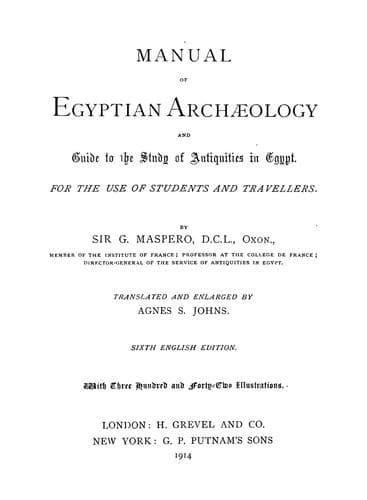
Manual of Egyptian Archaeology and Guide to the Study of Antiquities in EgyptMaspero, G. (Gaston)
History
Manual of Egyptian Archaeology and Guide to the Study of Antiquities in Egypt
Maspero, G. (Gaston)
Art -- Egypt; Egypt -- Antiquities
The first three dynasties of the New Empire[48] have bequeathed us more
monuments than all the others put together. Painted bas-reliefs, statues of
kings and private persons, colossi, sphinxes, may be counted by hundreds
between the mouths of the Nile and the fourth cataract. The old sacerdotal
cities, Memphis, Thebes, Abydos, are naturally the richest; but so great
was the impetus given to art, that even remote provincial towns, such as
Abû Simbel, Redesîyeh, and Mesheikh, have their _chefs-d'oeuvre_, like the
great cities. The official portraits of Amenhotep I. at Turin, of Thothmes
I. and Thothmes III. at the British Museum, at Karnak, at Turin, and at
Gizeh, are conceived in the style of the Twelfth and Thirteenth Dynasties,
and are deficient in originality; but the bas-reliefs in temples and tombs
show a marked advance upon those of the earlier ages. The modelling is
finer; the figures are more numerous and better grouped; the relief is
higher; the effects of perspective are more carefully worked out. The wall-
subjects of Deir el Baharî, the tableaux in the tombs of Hûi, of Rekhmara,
of Anna, of Khamha, and of twenty more at Thebes, are surprisingly rich,
brilliant, and varied. Awakening to a sense of the picturesque, artists
introduced into their compositions all those details of architecture, of
uneven ground, of foreign plants, and the like, which formerly they
neglected, or barely indicated. The taste for the colossal, which had
fallen somewhat into abeyance since the time of the Great Sphinx, came once
again to the surface, and was developed anew. Amenhotep III. was not
content with statues of twenty-five or thirty feet in height, such as were
in favour among his ancestors. Those which he erected in advance of his
memorial chapel on the left bank of the Nile in Western Thebes, one of
which is the Vocal Memnon of the classic writers, sit fifty feet high. Each
was carved from a single block of sandstone, and they are as elaborately
finished as though they were of ordinary size. The avenues of sphinxes
which this Pharaoh marshalled before the temples of Luxor and Karnak do not
come to an end at fifty or a hundred yards from the gateway, but are
prolonged for great distances. In one avenue, they have the human head upon
the lion's body; in another, they are fashioned in the semblance of
kneeling rams. Khûenaten, the revolutionary successor of Amenhotep III.,
far from discouraging this movement, did what he could to promote it.
Never, perhaps, were Egyptian sculptors more unrestricted than by him at
Tell el Amarna. Military reviews, chariot-driving, popular festivals, state
receptions, the distribution of honours and rewards by the king in person,
representations of palaces, villas, and gardens, were among the subjects
which they were permitted to treat; and these subjects differed in so many
respects from traditional routine that they could give free play to their
fancy and to their natural genius. The spirit and gusto with which they
Public-domain text, read in full here on John Shaqi.
Reviews
Reviews
No reviews yet
Be the first to share your thoughts on this work.
Elsewhere in the archive
Join the Discussion
Join the discussion
Sign in to leave a comment or review.
Sign InorCreate an account