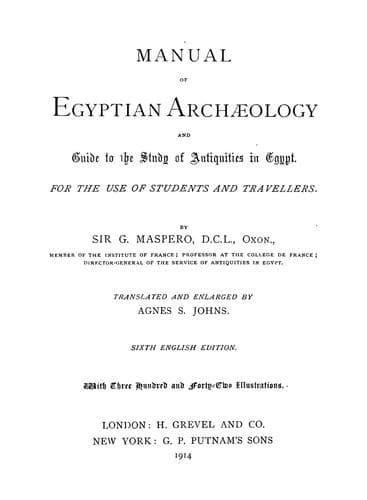
Manual of Egyptian Archaeology and Guide to the Study of Antiquities in EgyptMaspero, G. (Gaston)
History
Manual of Egyptian Archaeology and Guide to the Study of Antiquities in Egypt
Maspero, G. (Gaston)
Art -- Egypt; Egypt -- Antiquities
for fastening the peplum, rings and bracelets set with cameos, and caskets
ornamented at the four corners with little Ionic columns. The old patterns,
however, were still in request in remote provincial places, and village
goldsmiths adhered "indifferent well" to the antique traditions of their
craft. Their city brethren had meanwhile no skill to do aught but make
clumsy copies of Greek and Roman originals.
In this rapid sketch of the industrial arts there are many lacunae. When
referring to examples, I have perforce limited myself to such as are
contained in the best-known collections. How many more might not be
discovered if one had leisure to visit provincial museums, and trace what
the hazard of sales may have dispersed through private collections! The
variety of small monuments due to the industry of ancient Egypt is
infinite, and a methodical study of those monuments has yet to be made. It
is a task which promises many surprises to whomsoever shall undertake it.
[77] From the inscription upon the obelisk of Hatshepsût which is still
erect at Karnak. For a translation in full see _Records of the
Past_, vol. xii., p. 131, _et seqq._--A.B.E.
[78] Mr. Petrie suggests that this curious central object may be a royal
umbrella with flaps of ox-hide and tiger-skin.--A.B.E.
[79] That is, lentil-shaped, or a double convex.--A.B.E.
NOTES TO FIRST ENGLISH EDITION.
_For the following notes, to which reference numbers will be found in the
text, I am indebted to the kindness of Mr. W.M. Flinders Petrie, author of_
"The Pyramids and Temples of Gizeh" (Field & Tuer), "Tanis" (_Egypt
Exploration Fund_), "Naukratis" (_Egypt Exploration Fund), etc., etc._
A.B.E.
(1) More striking than these are the towns of Tell Atrib, Kom Baglieh, Kom
Abû Billû, and Tell Nebesheh, the houses of which may be traced without any
special excavations.
(2) There is much skill needed in mixing the mud and sand in such
proportions as to dry properly; when rightly adjusted there is no cracking
in drying, and the grains of sand prevent the mud from being washed away in
the rains.
(3) In the Delta, at least, the sizes of bricks from the Twenty-first
Dynasty down to Arab times decrease very regularly; under the Twenty-first
Dynasty they are about 18 x 9 x 5 inches; early in the Twenty-sixth, 16-1/2
x 8-1/4 x 5; later 15 x 7-1/2; in early Ptolemaic times, 14 x 7; in Roman
times, 12 x 6, in Byzantine times, 10 x 5; and Arab bricks are 8 x 4, and
continue so very generally to our times. The thickness is always least
certain, as it depends on the amount placed in the mould, but the length
and breadth may in most cases be accepted as a very useful chronological
scale.
(4) They are found of Ramesside age at Nebesheh and Defenneh; even there
they are rare, and these are the only cases I have yet seen in Egypt
earlier than about the third century A.D.
Public-domain text, read in full here on John Shaqi.
Reviews
Reviews
No reviews yet
Be the first to share your thoughts on this work.
Elsewhere in the archive
Join the Discussion
Join the discussion
Sign in to leave a comment or review.
Sign InorCreate an account